When you purchase through links on our site, we may earn a commission at no extra cost to you. Learn more.

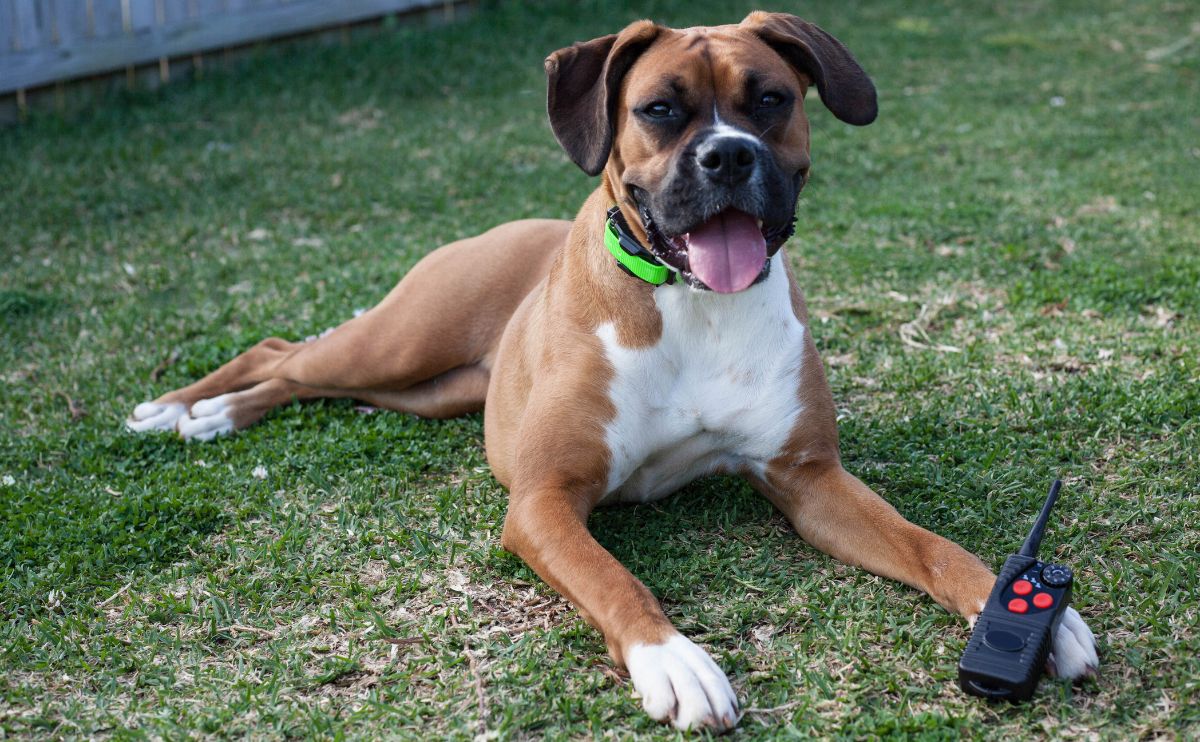
An invisible dog fence, also called an electric fence, is a wired fence placed underground. This creates an electrically charged boundary that keeps your pet within the confines of your yard without a physical fence. It is connected digitally to an invisible fence collar that the dog wears around its neck. So how exactly does an invisible fence work and what are its pros and cons?
Table of Contents
How Does An Invisible Fence Work?
Invisible fences operate on a system that transmits energy between the boundary line you establish, a home base monitoring/transmitter device, and the receiver that is attached to your dog’s collar. The actual fence is a set of electrically charged wires that are placed about 3-4 inches underground around the outer edges of your property. A transmitter is set up in your garage or on a wall in a room in your home. As your dog approaches the boundary line, the tone or vibration will deter her much the same way that an ultrasonic bark collar will deter the dog from barking.
More About The Electric Charge
The electric charge is similar to a quick splash of water on the face – just enough to surprise your pet and stop his movement, but not enough to hurt or cause any sort of damage. The amount of electric force that the receiver (collar) takes in and gives to your dog can vary depending on how you set the system up. The equipment will come with instructions on how much force is recommended for dogs at various weights. You can also experiment with the settings to find out exactly how much is required to keep your dog happy and confident while still maintaining safe boundaries within your set limits.
Many dog lovers worry that the electric shock is painful or emotionally devastating to a dog. However, if you hold the receiver (collar) in your hand and hold it over the boundary line you will find that it is neither painful nor shocking, but merely irritating. In other words, it is an effective and safe deterrent, when used correctly.
Features
Let’s look at the wired dog fence options currently available on the market. Just as there are many different kinds of traditional physical fences, there are also different types of wired dog fences. While the basic concept is the same, the qualities and features are not. Not all fences come equipped with these features.
Amount Of Shock
You should consider how many levels of correction the product offers. This feature refers to the amount of energy in the deterrent “shock” that was mentioned earlier. If you have a stubborn, strong-willed, or physically strong dog, or if you have multiple dogs of varying sizes, you will want to have more correction levels available in order to custom-design the corrections for your dog.
Battery-Backup Function
Some wired dog fences have a battery-backup function, but this is not standard with all systems. A battery-backup capability is a very good safety feature, covering the possibility that you forget to check the battery, or are late in changing it. It simply is not worth the risk to opt out of this feature.
Amount Of Interference
Another factor to consider is the amount of interference that could impact the deterrent to your pet. Some wired dog fences have low interference while others can be comparatively high. With all the potential interferences available in our environment these days, it is very important to find out what the capacity is for any wired dog fence you are seriously considering purchasing.
Creativity In Shaping Boundaries
Finally, you want to make sure you choose a wired dog fence that allows you to shape your boundaries any way you need to in order to maintain the integrity of your landscaping while still providing both safety and freedom for your dog. In other words, be aware that some wired dog fences have to be laid in a fairly square, round, or oval shape, while others can block off garden areas within the primary boundaries.
Is A Wireless Fence A Good Idea?
Sure you are considering am invisible fence, but how do you know whether its the best choice for your yard and family?
| Pros | Cons |
|---|---|
| No physical fence upkeep | Must check batteries regularly |
| Doesn’t change your landscaping | Installation may take some time |
| Provides safety for your dog while also giving them freedom | No protection from other animals getting inside the boundary |
| Some neighborhoods and cities have fencing laws or even prohibit fences altogether so this can be done in exchange | |
| Protects your dog from traffic, strangers, and any other dangers outside the boundary | |
| You don’t need to be an electrician to install it | |
| Cheaper than other a regular fence | |
| Helps train your dog |
Price Compared To Other Fences
Read our Wireless Dog Fence Reviews
It is difficult to compare costs in an information article like this because each person and each property is unique, so prices vary depending on the many variables involved. Therefore, for the sake of basic comparison, let’s just look at a 1/4 to 1/2 acre lot.
Chain Link Fence – A chain link fence that stands 4 feet high will run between $1,500 and $3,000 to install yourself; to do it professionally, it will cost between $4,000 and $7,500.
Invisible Fence – PetSafe Wireless Pet Containment System (View on Amazon) – A wireless invisible fence that covers an area up to 1/2 acre for $239.99 .
Wooden Fence – A ranch style wood fence is between $1,500 and $4,500 as a do it yourself project compared with $5,000 and $15,000 for professional installation.
Wired Dog Fence – Do it yourself options will start around $100 and take around 15 hours of your time vs. nearly $790 for a professionally installed wired fence.
Wired Dog Fence – Elite Little Dog In-Ground Fence (View on Amazon) – A wired invisible fence option for smaller dogs. This covers an area of around 1/3 of an acre for Check Amazon for availability .
Wired Dog Fence – SportDOG 100-Acre In-Ground Pet Fence System (View on Amazon) – A wired invisible fence option that covers an area up to 100 acres for Check Amazon for availability .
What’s Best For You And Your Dog?
Wired dog fences are convenient, attractive, safe, and affordable. Still, you will have to decide what is best for your personal lifestyle and the particular characteristics of your yard and your dog. The biggest decision will be whether you want to try and install it yourself or hire a professional. If you think you want to tackle this project yourself, find confidence in the fact that most companies that sell DIY wired dog fences also provide support and thorough instructions. Whatever you decide, look to the end product and imagine you are happily enjoying quality outdoor time with your best friend.
Overall the invisible fence collar is a safe way to train your dog as to his boundaries on your property; however, it is not recommended that a dog should be left outside without supervision, as the invisible fence does not keep other animals out of your property. Keep in mind, it is recommended that you consult your vet prior to implementing the fence and using the ultrasonic invisible fence collar.