When you purchase through links on our site, we may earn a commission at no extra cost to you. Learn more.
We all want more time with our dogs. So, how many years can you realistically expect? Dog life expectancy is typically 10 to 14 years, but no single lifespan applies to every pup.
Table of Contents
A tiny Chihuahua may still be bouncing around in its late teens while a giant Great Dane can be considered elderly years earlier.

Size is one of the biggest factors, but it isn’t the only one. Breed, genetics, body weight, nutrition, exercise, preventive veterinary care, and overall health can all influence how long a dog lives.
You cannot control your dog’s genetics, but you can influence many parts of their everyday care. Let’s look at how long dogs live, how lifespan changes by size and breed, and what you can do to help your pup enjoy as many healthy years as possible.
Want our human-written content to rank above AI-generated garbage? Help us out by clicking this button!
Dog Lifespan At A Glance
For a quick dog life expectancy estimate, start with your dog’s adult size.
| Dog Size | Typical Lifespan |
|---|---|
| Small Dogs | 10-15 years |
| Medium Dogs | 10-13 years |
| Large Dogs | 10-12 years |
| Giant Dogs | 8-10 years |
These are broad estimates, not expiration dates. Individual dogs can live shorter or considerably longer lives depending on breed, genetics, health, environment, and care.
Think of this size chart as your general starting point. The breed charts below provide more specific examples, while the longest- and shortest-lived breeds show the wider differences found across dog populations.
In general, small dogs tend to outlive large and giant dogs.
What Affects Your Dog’s Lifespan Most?
Dog life expectancy is shaped by factors you cannot change, such as genetics, breed, and adult size, as well as factors you can influence, including weight and everyday health care.
Understanding those differences can help you identify your dog’s risks without treating an average lifespan as a prediction.
Genetics & Breed
Genetics can influence susceptibility to cancer, heart disease, orthopedic problems, neurological conditions, and other illnesses that may affect longevity. This helps explain why two dogs of similar size can have noticeably different average lifespans.
Breed lifespan estimates provide a useful starting point, but family history, responsible breeding, health screening, and your dog’s individual health also matter.
Mixed Breed vs Purebred
Do mixed-breed dogs automatically live longer than purebred dogs? Not necessarily.
Genetic diversity may influence the risk of certain inherited conditions, but mixed ancestry does not guarantee a longer or disease-free life. Likewise, being purebred does not automatically mean a dog will have a shorter life.
The more useful approach is to consider your individual dog’s breed ancestry, expected size, family health history, lifestyle, and veterinary needs.

Weight & Obesity
Body weight is one of the most important health factors owners can influence. A study of 50,787 middle-aged, neutered dogs across 12 breeds found that overweight dogs had shorter median lifespans than dogs maintained at normal body condition in every breed studied.
Extra weight can also strain joints and complicate certain health problems. Ask your veterinarian what a healthy body condition looks like for your specific dog instead of relying solely on the number on the scale.
If your pup is carrying extra pounds, our guide to canine obesity explains what to look for and how to work toward a healthier weight.
Routine Veterinary Care
Preventive veterinary care can help identify health changes that aren’t obvious at home. Routine examinations allow your veterinarian to monitor your dog’s weight, heart and lung function, teeth, joints, skin, lumps, behavior, and other health indicators.
These visits become particularly valuable as dogs age and their health needs change.
Dental Health
Dental disease can cause significant pain and may progress without obvious signs because dogs often continue eating despite oral discomfort. Regular home care and veterinary dental evaluations can help identify and manage problems before they worsen.
Exercise
Regular movement helps support a healthy body condition, muscle strength, mobility, cardiovascular fitness, and mental well-being.
Exercise needs vary considerably by age, breed, health, and physical ability. The goal is consistent movement appropriate for your dog, not simply exercising them as much as possible.
Diet
Nutrition supports growth, body condition, muscle maintenance, and overall health throughout your dog’s life.
Calories matter too. Even a nutritious diet can contribute to excess weight when portions consistently exceed your dog’s needs.
Dog Life Expectancy By Size
One of the clearest patterns in dog life expectancy is that smaller dogs generally live longer than larger dogs.
That doesn’t mean every small dog will outlive every large dog. Across large populations, however, body size is strongly associated with lifespan.
Small Dogs: About 10-15 Years
Small dogs often have the longest lifespans, with many Chihuahuas, terriers, toy breeds, and other small dogs remaining active well into their teens.
For many small breeds, dog life expectancy extends well into the teenage years, although genetics and individual health still matter.
Because they generally age more slowly than giant breeds, the transition to senior-focused care may also happen later.
Medium Dogs: About 10-13 Years
Medium-sized dogs generally fall between small and large breeds in longevity. Breed and genetics can still create substantial differences, so two similarly sized dogs may have very different expected lifespans.
For example, the French Bulldog may face different health and longevity considerations than another dog of similar weight.
Large Dogs: About 10-12 Years
Large dogs generally reach their senior years sooner than small dogs. Owners of large dog breeds may therefore need to start paying closer attention to mobility, weight, muscle condition, and age-related health changes earlier.
Giant Dogs: About 8-10 Years
Giant breeds tend to have some of the shortest canine lifespans. An Irish Wolfhound, Great Dane, or Mastiff may reach its senior stage years before a much smaller dog.
Thinking about healthy aging early can help owners prepare for changes in mobility, weight, veterinary care, and comfort before problems become apparent.
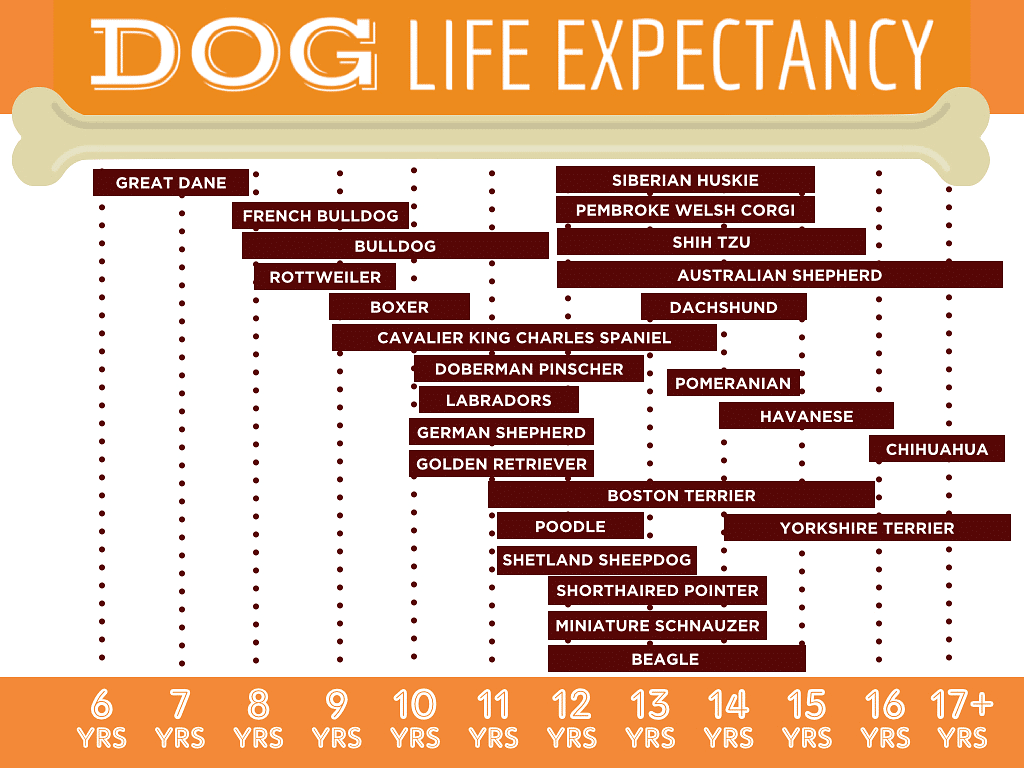
Dog Breed Life Expectancy Chart: 20 Common Breeds
The size chart above gives you a broad estimate. Breed lifespan ranges can narrow that estimate further, although they still cannot predict exactly how long an individual dog will live.
| Dog Breed | Average Lifespan |
|---|---|
| French Bulldog | 11-13 years |
| Labrador Retriever | 11 years |
| Golden Retriever | 11 years |
| German Shepherd | 11 years |
| Poodle | 12-15 years |
| Dachshund | 13-15 years |
| Bulldog | 8-12 years |
| Beagle | 12-15 years |
| Rottweiler | 9 years |
| German Shorthaired Pointer | 12-14 years |
| Pembroke Welsh Corgi | 12-15 years |
| Australian Shepherd | 12-18 years |
| Yorkshire Terrier | Around 13 years, with some living considerably longer |
| Cavalier King Charles Spaniel | 9-14 years |
| Doberman Pinscher | 10-13 years |
| Cane Corso | 9-12 years |
| Miniature Schnauzer | 12-14 years |
| Boxer | 9-10 years |
| Great Dane | 6-8 years |
| Shih Tzu | 10-16 years |
Treat these ranges as general breed guidelines, not guarantees. Population studies may also produce different figures depending on the dogs included and the method used to calculate longevity.
For more breed information, see our overview of the most popular registered breeds.
Which Dog Breeds Live The Longest?
Size explains part of dog life expectancy, but substantial differences also exist between breeds.
A 2024 Scientific Reports study analyzed 584,734 dogs in the UK, including 284,734 deceased dogs. Researchers examined how breed, body size, lineage, sex, and head shape affect longevity.
10 Longest-Lived Dog Breeds
These breeds had some of the highest median lifespans in the 2024 UK dataset:
| Dog Breed | Average Life Expectancy |
|---|---|
| Lancashire Heeler | 15.4 years |
| Tibetan Spaniel | 15.2 years |
| Bolognese | 14.9 years |
| Shiba Inu | 14.6 years |
| Papillon | 14.5 years |
| Havanese | 14.5 years |
| Lakeland Terrier | 14.2 years |
| Coton de Tulear | 14.2 years |
| Border Terrier | 14.2 years |
| Schipperke | 14.2 years |
Keep in mind that these median lifespans come from one large UK study. Don’t treat them as guaranteed lifespans for individual dogs or compare them directly with every general breed range you may see elsewhere.
Exceptional dogs sometimes live much longer. Bluey, an Australian Cattle Dog, lived for 29 years and five months and held the long-standing Guinness World Records benchmark for canine longevity.
Spike, a Chihuahua mix from Ohio, was recognized by Guinness World Records as the oldest living dog in early 2023 at more than 23 years old.
Cases like these are extraordinary and shouldn’t be treated as realistic expectations for every dog of the same breed.
Which Dog Breeds Have Shorter Life Expectancies?
The same 2024 research found substantial differences at the other end of the lifespan spectrum.
Several breeds with relatively low median lifespans in that UK dataset included the Caucasian Shepherd, Presa Canario, Cane Corso, Mastiff, Saint Bernard, Affenpinscher, Bulldog, French Bulldog, Bloodhound, and Neapolitan Mastiff.
Many are large or giant breeds, although size isn’t the only factor involved. Breed-specific anatomy and inherited health risks can also affect longevity.
Seeing your dog’s breed associated with a shorter lifespan can be difficult, but population data cannot tell you how long your individual dog will live.
Use the information to understand which health concerns deserve attention and when conversations about age-related care may need to begin.
Why Some Dogs Die Earlier Than Expected
Average dog life expectancy tells us approximately how long groups of dogs live. They cannot explain exactly why an individual dog may die earlier than expected.
Genetics, inherited disease, body structure, illness, accidents, and other health factors can all play a role. Flat-faced dogs such as French Bulldogs, for example, can experience breathing and heat-related health problems associated with brachycephalic anatomy.
Knowing about breed-related risks can help owners and veterinarians decide which health problems deserve closer monitoring.
Common Causes Of Early Death In Dogs
Causes of premature death vary with age, breed, size, lifestyle, and health.
In younger dogs, risks can include trauma, infectious disease, congenital disorders, and sudden illness. As dogs get older, chronic diseases become increasingly important. Cancer is a significant concern, particularly in some breeds.
You don’t need to worry about every possible disease. Instead, learn your dog’s individual risks and seek veterinary care when something changes.
When Should I Start Senior Dog Care?
Don’t wait for gray fur or obvious slowing down before thinking about senior care.
There isn’t one birthday when every dog suddenly becomes a senior. The American Animal Hospital Association defines the senior stage as approximately the final 25% of a dog’s expected lifespan.
That means a dog with a shorter expected lifespan will generally enter the senior stage earlier than a dog expected to live well into its teens.
Rather than relying on a rigid age cutoff, ask your veterinarian when senior-focused monitoring makes sense for your dog’s breed, size, health history, and expected lifespan.
What Changes When Your Dog Becomes A Senior?
Senior care increasingly focuses on detecting subtle changes early while preserving comfort, mobility, independence, and quality of life.
Your veterinarian may recommend more frequent examinations or age-appropriate screening based on your dog’s individual health risks.
Starting these conversations before your dog looks or acts old can also establish useful health baselines for comparison as they age.
How Can I Help My Dog Live A Longer, Healthier Life?
The factors above explain why dog life expectancy differs. This section covers what you can control.
No food, supplement, test, or routine can guarantee that your dog will live longer. Everyday health decisions can, however, support their chances of enjoying more healthy years.
1. Keep Your Dog Lean
Learn what an ideal body condition looks and feels like for your dog. Measure meals rather than guessing, account for treats, monitor weight changes, and adjust portions as activity levels change.
If you’re unsure whether your dog is at a healthy weight, ask your veterinarian to assess their body condition.
2. Stay Ahead Of Health Problems
Don’t wait until your dog appears sick to schedule veterinary care.
Keep up with preventive appointments and ask your veterinarian which examinations, vaccinations, parasite prevention, bloodwork, or other screenings are appropriate for your dog’s age and health.
As your dog enters their senior years, ask whether their checkup schedule should change.
3. Protect Their Teeth
Make dental care part of your dog’s routine before problems become obvious. Get your dog comfortable with appropriate home dental care and ask your veterinarian how often professional dental evaluations or cleanings are needed.
Persistent bad breath, difficulty chewing, bleeding gums, loose teeth, or other oral changes deserve veterinary attention.
4. Feed For Health, Not Hype
Choose a complete and balanced diet appropriate for your dog’s age, size, health, and activity level, and monitor portion sizes carefully. All-natural fresh dog food has become popular, but fresh isn’t automatically the best choice for every dog.
If you’re considering another feeding approach, our team has tried and reviewed some of the best dog food delivery services, including traditional and fresh options.
Whatever you feed, maintaining a healthy body condition matters more than following the latest food trend.
5. Keep Them Moving
Adjust exercise to your dog’s age, health, breed, and physical ability rather than stopping activity simply because they’re getting older.
For senior dogs, shorter walks, time to sniff, gentle play, and veterinarian-approved activities can help them stay active and engaged. Our guide explains how often and how long to walk your dog based on different needs.
If your dog enjoys chasing toys, teaching them to fetch can provide exercise and interactive play.
6. Notice Changes Early
You know what’s normal for your dog. Watch for unexplained changes in appetite, drinking, weight, energy, breathing, mobility, sleep, bathroom habits, behavior, lumps or bumps, vision, or hearing.
A change doesn’t automatically mean something serious is wrong, but persistent, sudden, or concerning changes deserve veterinary attention.
7. Prepare For Veterinary Costs Before You Need Care
Unexpected veterinary treatment can be expensive, particularly as dogs age. An emergency savings fund or pet insurance may help some families prepare for unexpected bills.

Insurance itself doesn’t extend a dog’s lifespan. Its role is financial. It may make costly veterinary treatment easier for some owners to manage when their dog becomes sick or injured.
Does Spaying Or Neutering Affect Lifespan?
Research has found an association between sterilization and longevity, but that doesn’t mean spaying or neutering automatically adds a set number of years to every dog’s life.
A study of more than 40,000 dogs found that sterilized dogs lived longer on average than reproductively intact dogs. However, sterilization was also associated with different patterns in causes of death, including lower risks from some causes and higher risks from others.
Breed, sex, age at surgery, reproductive status, cancer risk, orthopedic health, and lifestyle can all complicate the relationship.
For that reason, a universal recommendation that every dog should be spayed or neutered at a particular age to increase lifespan is too simplistic.
Discuss the benefits, risks, and appropriate timing with your veterinarian based on your dog’s breed, sex, expected adult size, health, lifestyle, and reproductive plans.
How Old Is My Dog In Human Years?
You’ve probably heard that one dog year equals seven human years. Canine aging isn’t that simple.
Dogs mature quickly during their first years, and aging patterns differ by size and breed. Our dog-to-human years guide explains how to make a more useful comparison.
Can DNA Tell Me How Old My Dog Is?
If you adopted a dog with an unknown history, estimating their age can be difficult. Some genetic tests estimate age using DNA methylation, an age-related epigenetic change.
Embark currently offers a Dog Age Test that uses methylation patterns to estimate a dog’s age and likely birthdate range. According to Embark, the result is an estimate rather than an exact birthdate, and its current model places the true birthdays of 77% of tested dogs within 12 months of the estimated birthday.
Visit Embark DNA for more information.
If you aren’t sure about your dog’s ancestry either, a dog DNA test may help identify likely breed ancestry and some genetic health risks. We’ve also shared our experience in our Wisdom Panel review.
Treat DNA age results as estimates, not exact birth records or predictions of how long your dog will live.
What About Anti-Aging Drugs For Dogs?
Researchers are investigating if specific biological processes that cause canine aging can be slowed or altered with medication. Loyal is one company developing drugs intended to address age-related decline and longevity in dogs.
This is still a developing area. Anti-aging research should not distract from the measures already available to owners, including maintaining a healthy body condition, appropriate nutrition and exercise, preventive veterinary care, dental care, and prompt attention to health changes.
Frequently Asked Questions
Dog lifespan can bring up surprisingly emotional questions. Here are some of the most common questions dog owners ask. If you don’t find yours, drop it in the comments.
What Is The Average Lifespan Of A Dog?
Dog life expectancy is roughly 10 to 14 years, although size, breed, genetics, health, and care can significantly affect how long an individual dog lives.
Do Small Dogs Live Longer Than Large Dogs?
Generally, yes. Small dogs commonly live into their teens, while large and giant breeds tend to have shorter average lifespans.
Do Mixed-Breed Dogs Live Longer Than Purebred Dogs?
Not necessarily. Large studies have found differences associated with lineage, but breed, body size, genetics, health, and other characteristics also influence longevity. Mixed ancestry alone cannot tell you how long an individual dog will live.
Do Female Dogs Live Longer Than Male Dogs?
Although some large studies have found differences between male and female dogs, sex has a much smaller effect on lifespan than other factors and cannot reliably predict how long a specific dog will live.
Can A Dog Live 20 Years?
Yes, but it is unusual. Some dogs, particularly smaller breeds, reach 20 years, but that should be considered exceptional rather than typical.
Can Dogs Live Nearly 30 Years?
Yes, but verified cases are extraordinarily rare. Bluey, an Australian Cattle Dog, lived for 29 years and five months. Cases approaching that age should not be used as realistic lifespan expectations for most dogs.
Does Having Puppies Shorten A Dog’s Lifespan?
Pregnancy itself does not mean a dog will have a shorter life, but pregnancy and birth carry medical risks that vary with age, breed, health, litter size, and reproductive history. Our guide to dog pregnancy tests explains how to identify and monitor pregnancy.
Can I Actually Make My Dog Live Longer?
You cannot guarantee a particular lifespan. Maintaining a healthy weight, providing appropriate nutrition and exercise, keeping up with preventive and dental care, and responding promptly to health changes can support your dog’s health throughout their life.
Every Healthy Year Matters
Finding your dog’s breed on a lifespan chart can be reassuring or surprisingly emotional. But a lifespan estimate cannot predict your dog’s individual story.
Use these numbers for what they’re best at: planning, understanding when senior care may need to begin, and making informed health decisions as your dog’s needs change.
Dog life expectancy is a planning tool, not a countdown. What matters most is helping your dog stay healthy, comfortable, mobile, and engaged throughout the years you have together.
How old is your dog, and does their age surprise you compared with the average lifespan for their breed or size? Tell us about your pup in the comments below. We’d especially love to hear from owners whose dogs have reached their senior years or lived well beyond their breed average.
If this guide helped you understand your dog’s lifespan, explore our related guides on dog longevity, senior care, nutrition, exercise, and health to support your pup at every stage of life.