When you purchase through links on our site, we may earn a commission at no extra cost to you. Learn more.
You lean down to say hello, and suddenly your dog’s tongue is all over your face. Sometimes it’s a quick lick. Other times, it feels like a full-on slobber assault.
Table of Contents
So why do dogs lick your face?
While it’s often framed as a sign of love, face licking isn’t always about affection. Dogs lick for several reasons, and understanding which one applies to your dog can change how you feel about the behavior and whether you allow it, redirect it, or stop it altogether.
Start Here: Is Face Licking Normal Or A Sign Of Something Else?
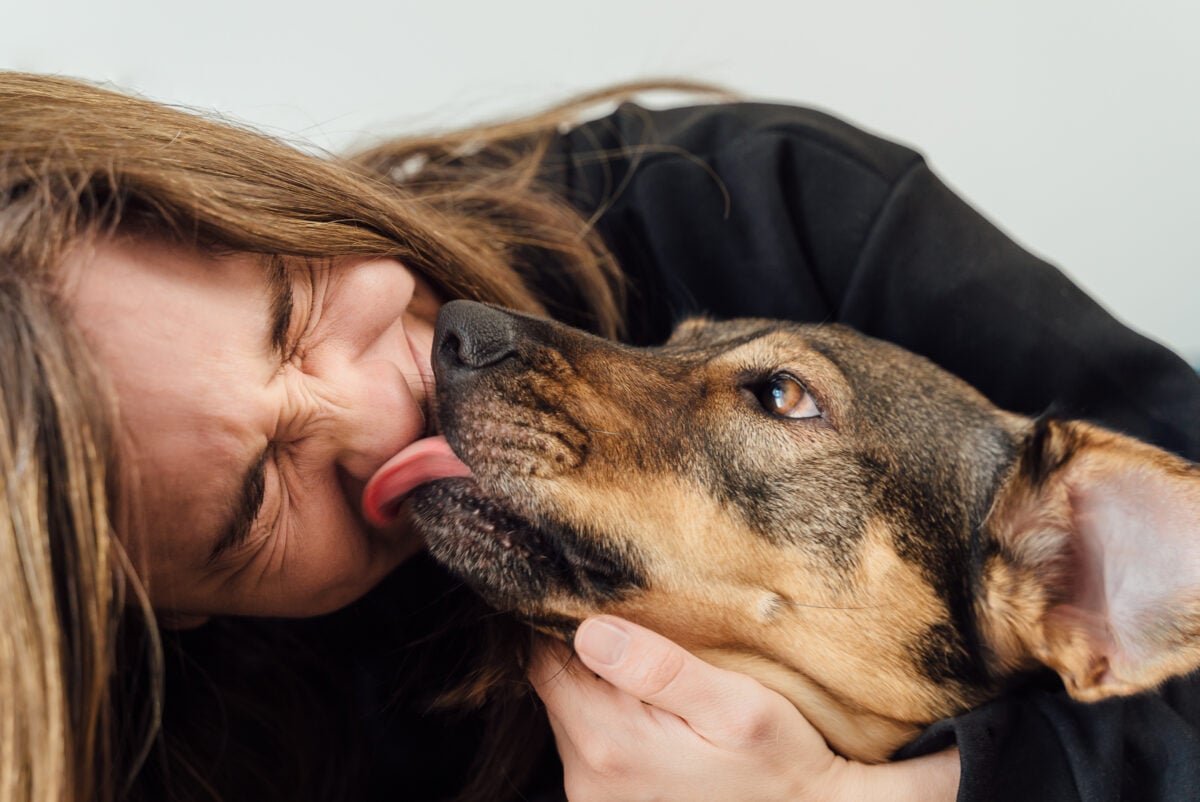
In most cases, face licking is completely normal dog behavior. It’s one of the ways dogs communicate, bond, and interact with the people they trust most.
That said, how and when your dog licks your face matters. A quick lick when you get home, during cuddles, or after you’ve been away is very different from constant, frantic licking that feels difficult to interrupt.
Occasional face licking usually signals affection, excitement, or social bonding. Persistent or intense licking, however, can point to learned attention-seeking, anxiety, or overstimulation.
Before deciding whether face licking is something you want to allow, it helps to understand what’s driving the behavior. Once you know the reason, it becomes much easier to set boundaries without confusing or frustrating your dog.
Below, we’ll break down the most common reasons dogs lick faces, when licking can become a problem, and how to gently discourage it if it’s not something you enjoy.
Could Excessive Licking Ever Signal A Health Issue?
Most face licking is completely normal. But if your dog suddenly starts licking obsessively — whether it’s your face, their paws, furniture, or the air — it can sometimes point to an underlying medical issue.
Allergies, dental pain, nausea, anxiety disorders, or even neurological conditions can trigger excessive licking. If the behavior feels new, intense, or difficult to interrupt, it’s worth mentioning to your veterinarian.
And that’s where planning ahead matters.
Unexpected vet visits for diagnostics, allergy testing, dental procedures, or behavioral evaluations can add up quickly. Pet insurance can help cover exams, testing, and treatment for newly diagnosed conditions, giving you the freedom to focus on your dog’s health instead of the bill.
If you’re considering coverage, explore our in-depth guide to the best pet insurance plans for dogs to compare options and see what’s typically covered.
Because when something changes in your dog’s behavior, you want answers — not financial stress.

Why Dogs Lick Faces at All (The Behavioral Science)
Licking is a natural form of communication for dogs. From the time they’re puppies, dogs use their mouths to interact with their world, their littermates, and their mother. It’s one of the earliest ways they learn to bond, seek care, and exchange information.
Unlike humans, dogs don’t have hands to explore or connect. They rely on their mouths, noses, and tongues to investigate, self-soothe, and communicate socially. Face licking taps into all three.
Because face licking often leads to attention, affection, or interaction from humans, the behavior becomes reinforced over time. That’s why licking isn’t driven by a single emotion. It’s a flexible behavior that can mean different things in different contexts.
Dogs, Saliva, & The Human Microbiome
Research suggests that close contact between humans and dogs plays a role in shaping the human microbiome, especially during early life. Studies have found that children who grow up with dogs tend to have more diverse gut bacteria and, in some cases, improved social and emotional outcomes.
One study observed that adolescents who lived with dogs showed differences in gut microbiota linked to reduced depression and increased sociability, with microbial transfer likely occurring through everyday contact, including saliva exposure. Other research has found that infants exposed to household pets show measurable changes in gut microbiota during key developmental windows.
These findings don’t suggest that face licking is necessary or recommended. Instead, they highlight how closely canine social behaviors evolved alongside human biology and why close physical interaction remains such a natural part of the human–dog bond.
What Your Dog Is Actually Saying When They Lick Your Face
Dogs don’t lick faces for just one reason. The meaning depends on timing, intensity, and what’s happening around them. Here are the most common explanations, starting with the ones owners recognize fastest.
1. Attention-Seeking (Learned Behavior)
For many dogs, face licking works. It interrupts what you’re doing, pulls your focus back to them, and almost always triggers a response, even if that response is telling them to stop.
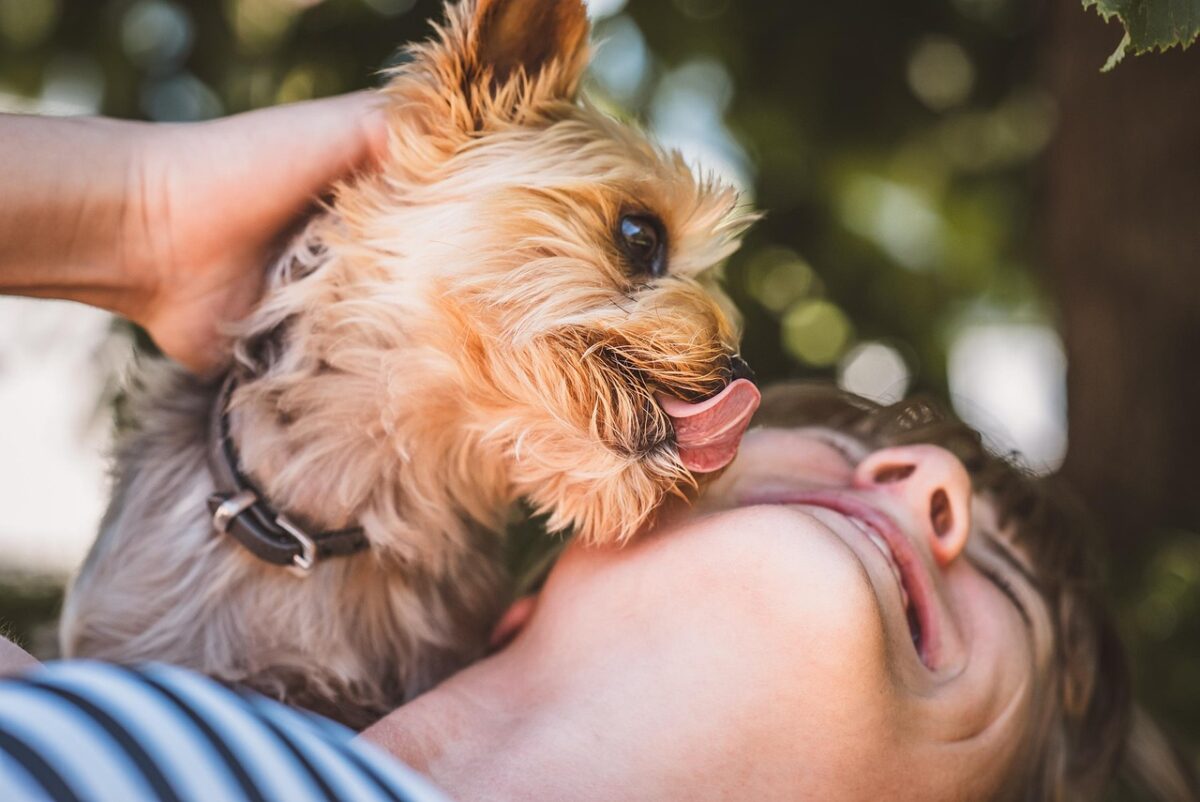
Dogs are excellent pattern learners. If licking your face consistently leads to eye contact, talking, laughter, or touch, they learn to use it as a reliable way to get engagement. Over time, what starts as a greeting can turn into a default strategy for getting your attention.
If this sounds familiar, your pup might be bored, a little lonely, or just craving interaction. Consider redirecting that energy with a quick walk, a play session, or a toy to keep their brain and paws busy.
See our reviews of the best interactive dog toys and brain games for dogs to keep your pup mentally and physically stimulated.
Common Variation: Greeting Ritual
Some dogs aren’t actively demanding attention at all. Face licking simply became part of their greeting routine early on and was reinforced repeatedly.
In these cases, the behavior is automatic rather than emotional, similar to jumping or spinning when someone walks through the door.
2. Affection & Social Bonding
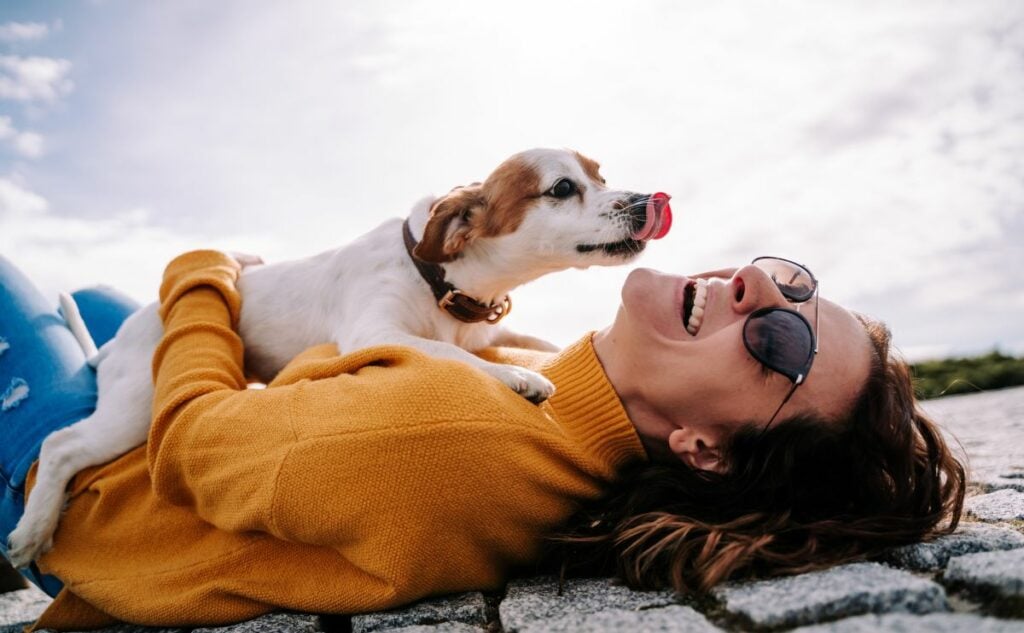
Face licking can be a genuine sign of affection. Many dogs lick the people they feel closest to during greetings, cuddling, or calm bonding moments.
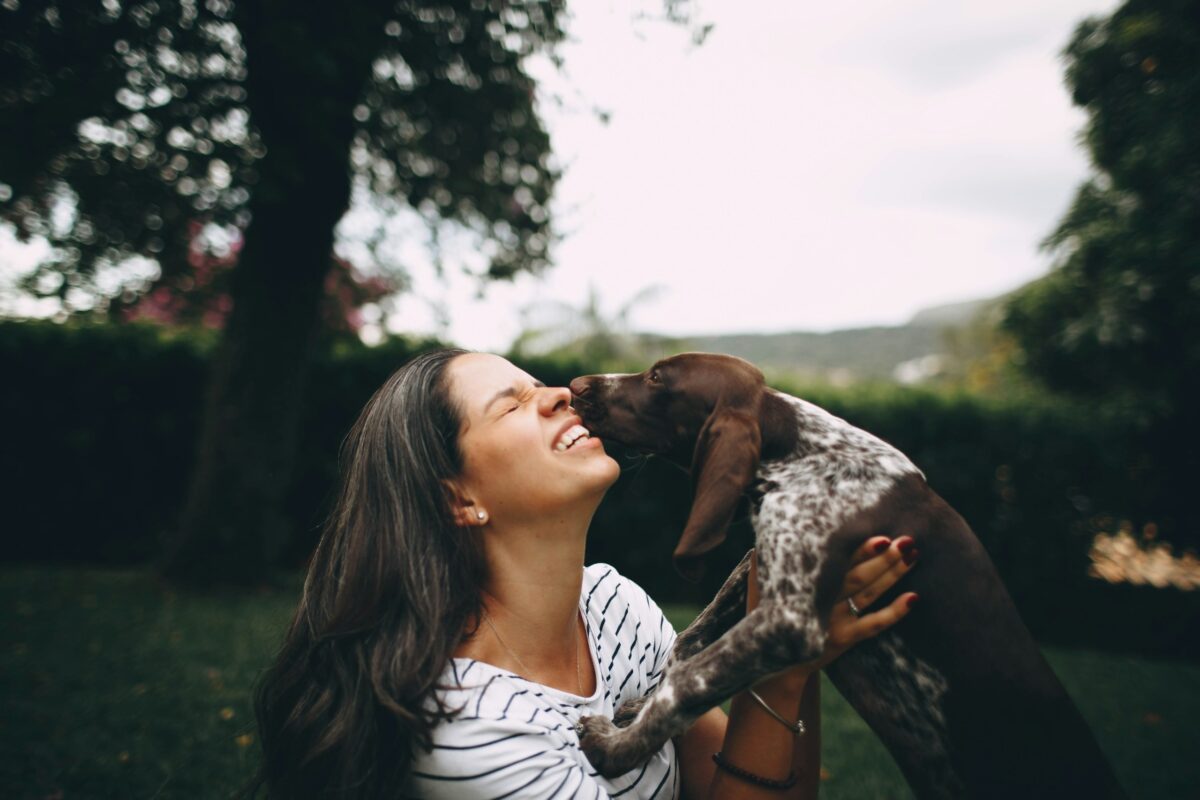
This behavior traces back to puppyhood, when licking is part of social connection between a mother and her litter. When a dog offers gentle, relaxed licks and settles afterward, it’s often their way of reinforcing trust and closeness.
3. Instinct From Puppyhood
In early development, puppies lick their mother’s muzzle to stimulate feeding and maintain social bonds. While adult dogs don’t rely on this behavior for survival, the instinct itself remains.
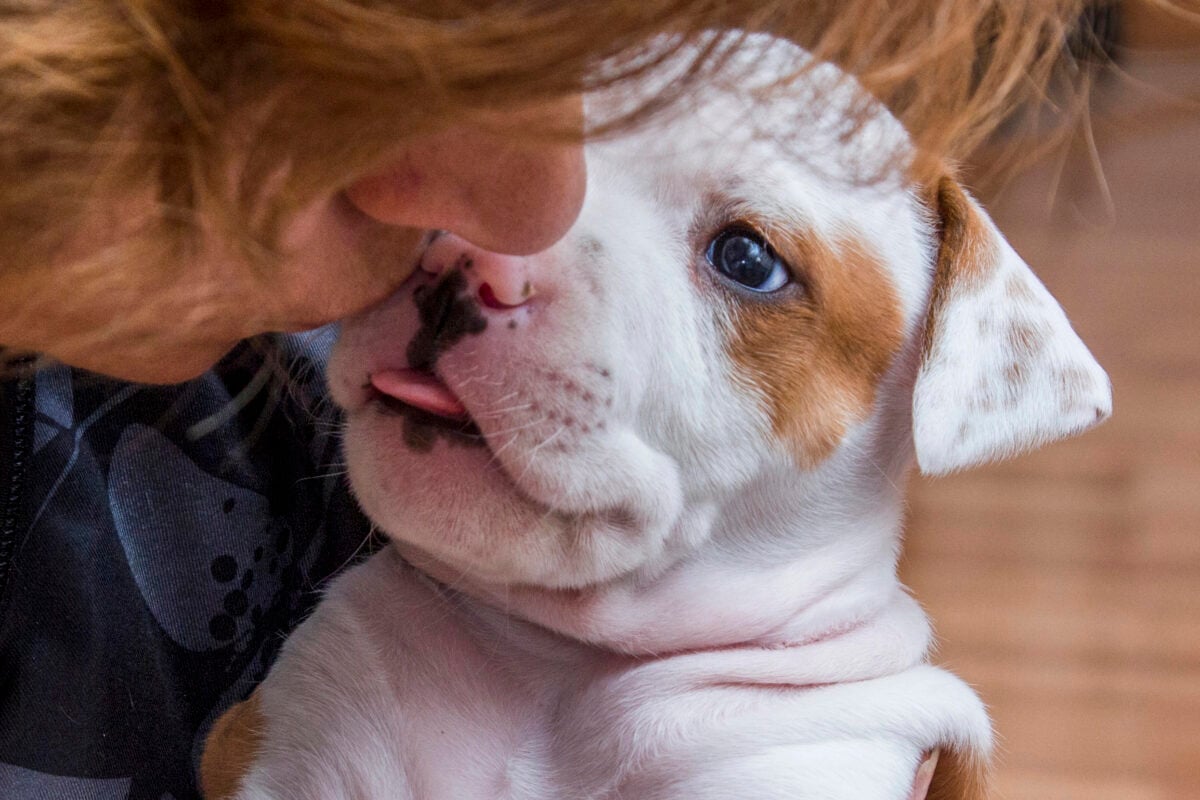
As dogs mature, that same behavior shifts into broader social communication. Humans become part of the dog’s social group, and faces naturally become a focal point. Over time, dogs learn that licking human faces often leads to interaction, affection, or reassurance.
4. Emotional Regulation & Appeasement Behavior
Licking can also help dogs manage emotions. The repetitive motion releases calming chemicals in the brain, which is why licking often appears during moments of excitement, uncertainty, or stress.
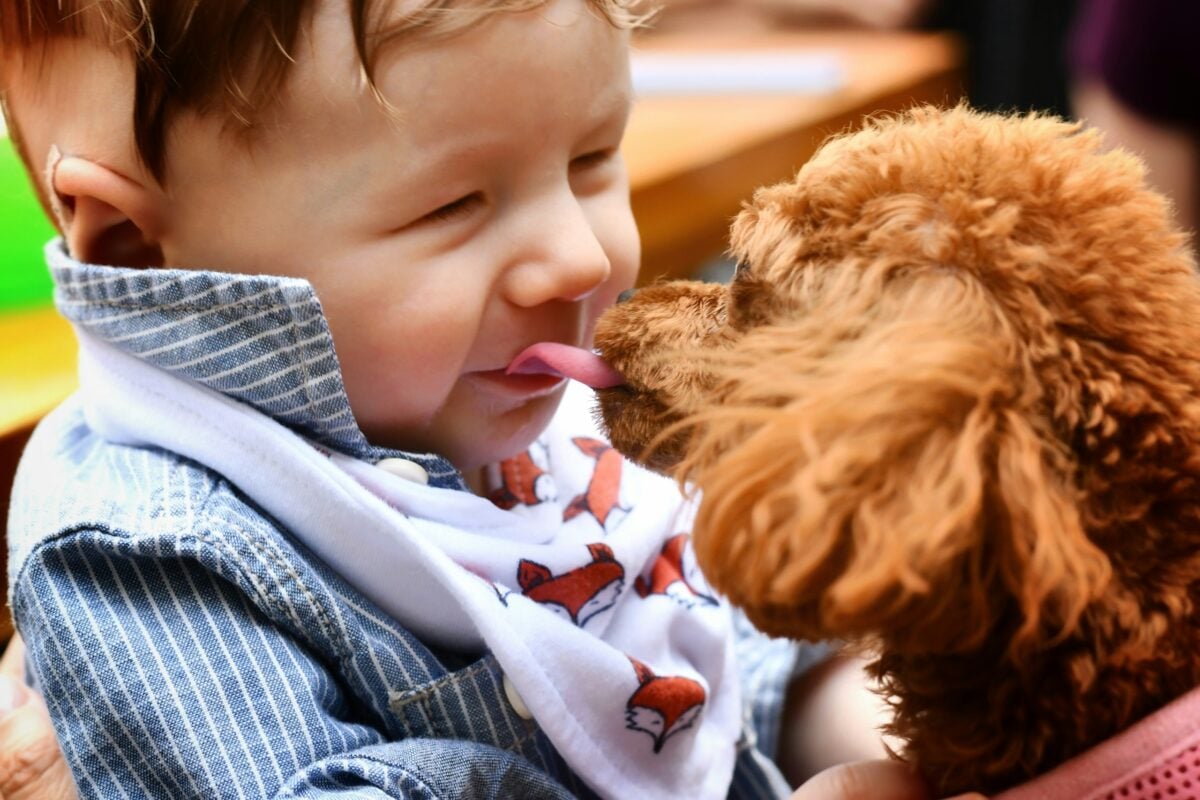
In some cases, face licking functions as an appeasement signal. A dog may lick your face when you lean over them, speak firmly, or return after an absence as a way to diffuse tension and maintain social harmony. This is not submission in a dominance sense, but rather aconflict-avoidant communication strategy.
When licking appears alongside other stress signals, such as yawning, lip licking, or body stiffness, emotional regulation is often the driving factor.
When Excessive Licking Is A Problem
While occasional licking is normal, constant licking of you, themselves, or random surfaces can be a sign of significant anxiety or even a compulsive disorder.
If the licking seems excessive or disruptive, talk to your vet. They may refer you to an animal behaviorist or suggest anti-anxiety medication as part of a broader training plan.
5. Information Gathering
Dogs experience the world through chemical cues. Your face carries a constantly changing mix of scents related to where you’ve been, what you’ve touched, and even how you’re feeling.

Licking allows dogs to collect information beyond what scent alone provides. Sweat, tears, and skin secretions contain compounds that can signal emotional state, stress, or excitement. In this context, face licking is less about affection and more about sensory data.
To your dog, your face is a highly informative surface.
6. You Taste Interesting
Sometimes the explanation really is simple.
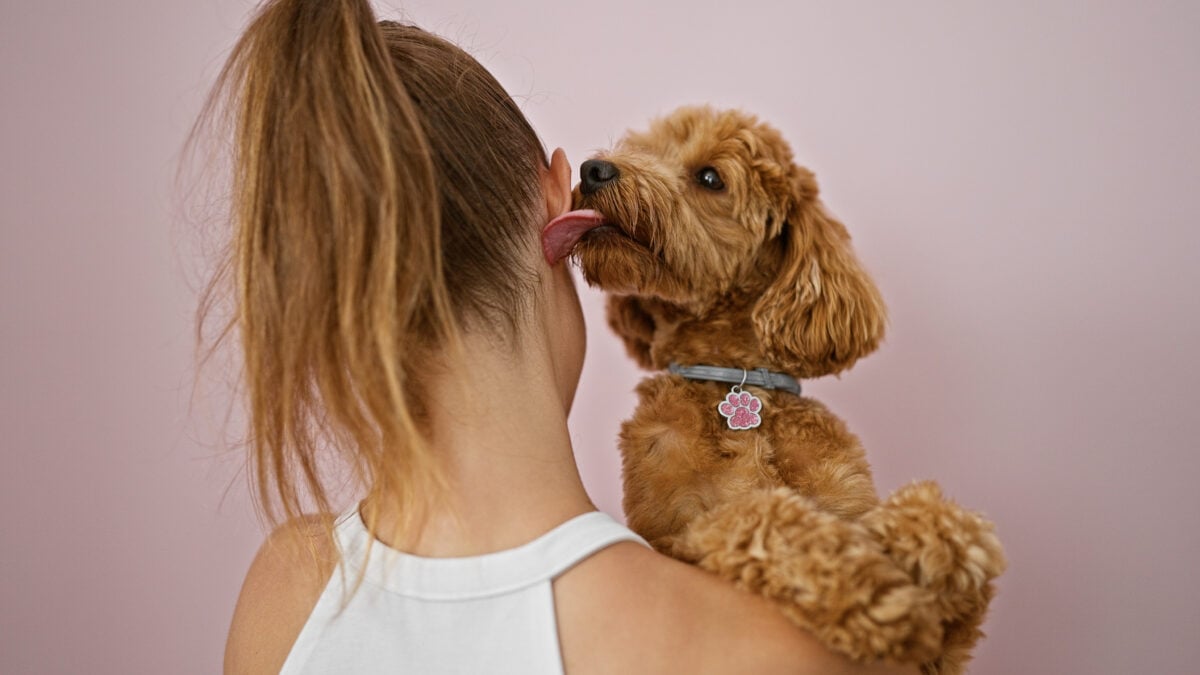
Human skin can taste salty after exercise, emotional crying, or a warm day. Residual food smells, skincare products, and natural oils can also make faces appealing.
For dogs with strong sensory drives, taste alone can be enough motivation.
Is It Safe To Let Your Dog Lick Your Face?
For most healthy adults, occasional face licking is low risk and usually nothing to worry about. That said, your health, your dog’s health, and where exactly that tongue is landing all matter.
Many people allow face licking without a second thought, but there are a few situations where extra caution makes sense. Understanding those risks helps you make informed choices without unnecessary concern.
To be safe, you may want to wash your face or clean the area after your dog licks you, especially if licking happens frequently.
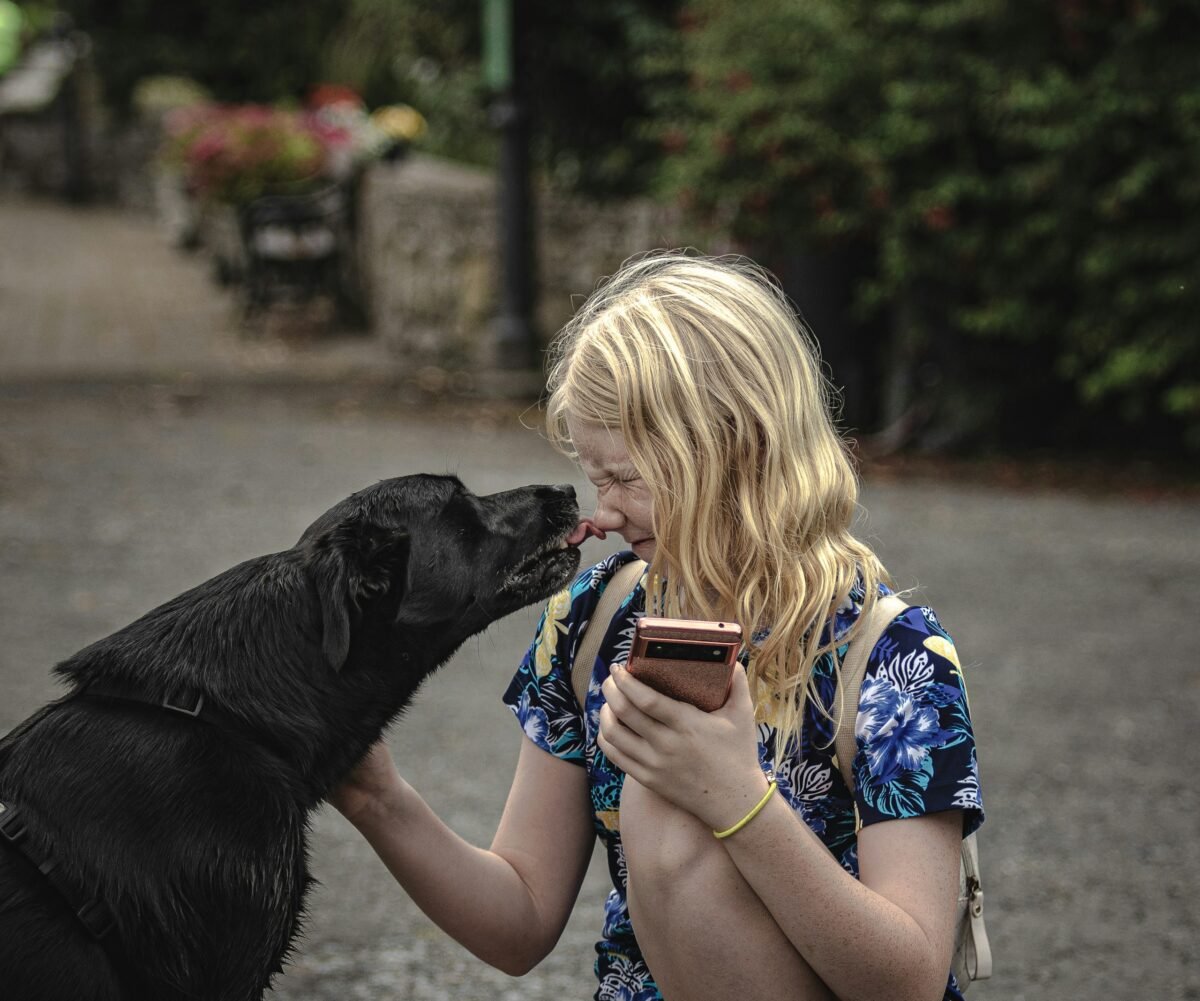
1. Dogs’ Mouths Contain Potentially Harmful Germs
Dog saliva isn’t sterile. In fact, it can contain bacteria (like Capnocytophaga), which can be passed to humans (although that’s rare). Serious illness from a lick is rare, but risk increases if:
- You have an open wound or scratch where your dog licks
- Your immune system is weakened due to age, illness, or medication
- Your dog has poor dental hygiene or an untreated tooth infection
For most people, healthy skin provides an effective barrier.
2. Avoid Mucous Membranes
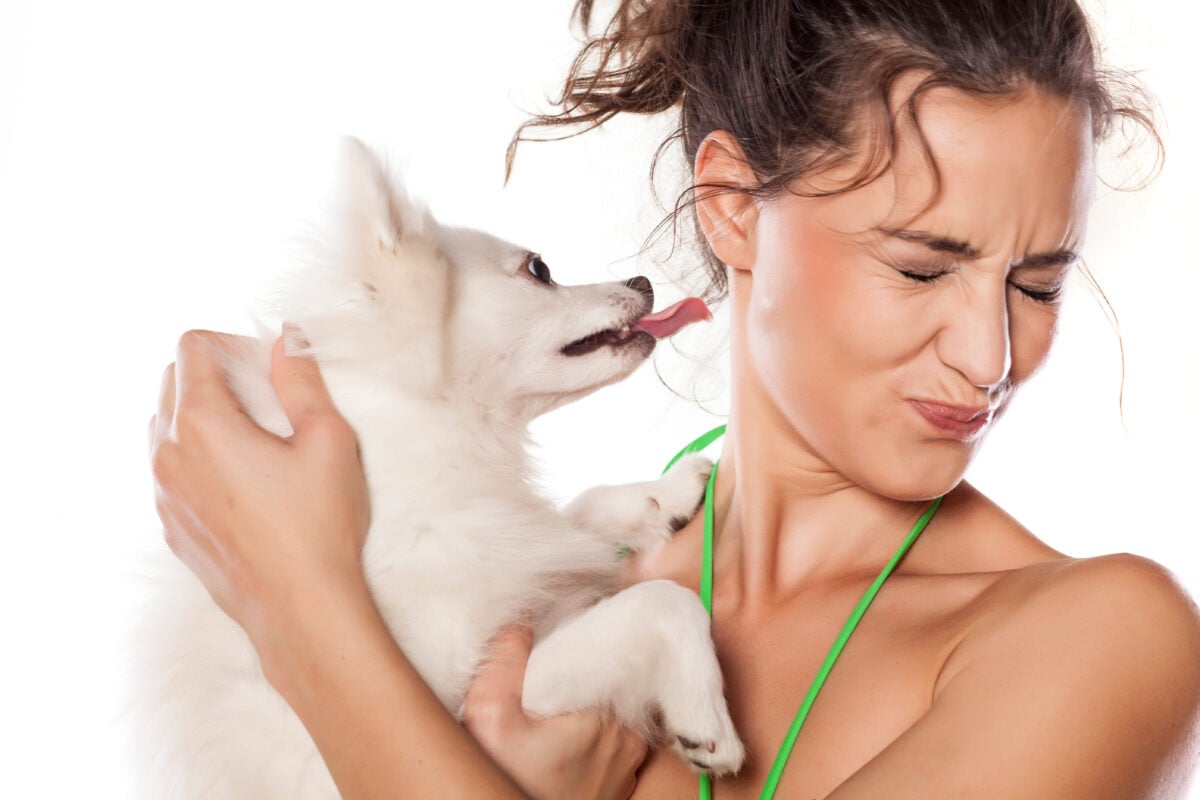
If your dog’s tongue heads for your mouth, nose, or eyes, it’s best to redirect. These areas are more vulnerable to infection than intact skin, and bacteria can enter more easily through tiny breaks in the mucosa.
This is one of the clearest places where setting boundaries is a good idea.
3. Parasites Are Also A Consideration
If your dog regularly licks or eats things outside like garbage, animal feces, or dead critters — or if your pup licks their own butt — they could carry parasites such as giardia or hookworms. While transmission to humans from licking is uncommon, it’s not impossible.
What About Children?
Extra care is recommended when it comes to babies and young children. Kids’ immune systems are still developing, and they’re more likely to have small cuts, face-touching habits, or hands in their mouths after close contact with pets.
This doesn’t mean dogs and kids can’t be affectionate. It simply means face licking, especially around the mouth, nose, and eyes, should be gently discouraged. Teaching dogs to show affection in other ways and helping children wash their hands after close interaction goes a long way.
Helpful Guidelines For Families
While research suggests that early exposure to household pets can influence the developing microbiome, close face licking around babies and young children should still be discouraged in favor of supervised, hygienic interaction.
- Supervise all close face-to-face interactions
- Redirect licking away from a child’s face
- Encourage handwashing after playtime
With basic hygiene and supervision, dogs and kids can safely share plenty of affection.
Our Personal Experience With Face Licking
My dog Falkor, a Poodle-Beagle mix, acts like I’m the center of his universe. The second I walk through the door, he’s already vibrating with excitement.
It doesn’t matter if I’ve been gone for hours or just stepped outside to grab the mail. His enthusiasm is Olympic-level. His tail wags so hard I’m sure he’s one spin away from liftoff.
As soon as I free him from his crate, Falkor transforms into a licking machine. Usually, it’s a sweet, gentle “hello.” But sometimes, he gets carried away, like he’s trying to exfoliate my face with his tongue.
I’ve had moments where I’ve had to gently remind him, “Falkor, I need an oxygen mask, buddy!” Still, it’s impossible to be mad at him when he looks so proud of his handiwork.
Those slobbery kisses? They melt my heart every time.
Sure, I’ve invested in dog toothpaste and toothbrushes because, let’s face it, no one wants stinky breath on their cheeks. But even with all the mess and the occasional overzealous licks, I wouldn’t trade those moments of pure, unfiltered love for anything in the world.
– Danielle DeGroot, Rescue Dog Mom & Canine Journal Writer
5 Tips To Stop Unwanted Face Licking (Without Punishment)
Even though there’s a minimal health risk, not everyone is a fan of having a dog’s tongue all over their face. If your dog is too aggressive with licking or you simply can’t stand the slobber on your face, there are some ways you can deter this behavior.
These tips can also help you keep your pup from licking other people’s faces.
1. Don’t Reinforce The Behavior
Avoid reacting with laughter, petting, or verbal responses. Even negative attention can reinforce licking if your dog is seeking engagement.
Instead, calmly turn your head or shift your body away without making it a big moment. This removes the reward without creating confusion or stress.
2. Ignore Briefly, Then Reward Calm Behavior
If your dog licks and you quietly disengage, they’ll start to associate face licking with a lack of payoff. When they pause, settle, or keep their tongue to themselves, offer praise or a small treat.
The timing matters. Rewarding calm behavior helps your dog learn what does work.
3. Teach A Clear, Neutral Cue
Use a consistent phrase like “No kisses” or “That’s enough” when licking starts. Keep your tone calm and matter-of-fact rather than stern.
Dogs respond best to cues that are predictable and emotionally neutral.
4. Redirect The Behavior
Give your dog something else to do when they go in for a lick. A chew toy, treat-dispensing puzzle, or simple cue like “sit” followed by a reward can redirect that energy into an appropriate outlet.
This works especially well for dogs who lick out of excitement or habit.
5. Create Clear Physical Boundaries
If face licking happens most often during cuddling or when you’re lying down, teach your dog to settle in a nearby spot or on their bed instead of being in your face.
Boundaries don’t reduce affection. They help dogs understand expectations.
Over time, most dogs learn that licking isn’t the behavior that earns attention.
Need Help Training?
Unsure how to train your dog to understand and respond to cues or commands? Read our guide on obedience training to brush up on basic skills. You may also want to consider an online dog training course, which is an easy, affordable alternative to hiring a personal trainer.
Frequently Asked Questions
Do you still have questions? Here are some we get often about dog licking. If you don’t see yours here, please respond us in our comments.
What Does It Mean When A Puppy Licks Your Face?
The dog licking face meanings above are essentially the same for puppies, except they may do it more often. Remember, puppies likely still retain the instinct to lick their mother or littermates for some time after leaving their furry family.
Why Do Dogs Lick Your Face When You Cry?
Dogs are highly sensitive to human emotions. When you cry, your dog may pick up on your distress through your tone, body language, and even scent changes.
Licking your face can be their way of offering comfort, showing empathy, or trying to soothe you — similar to how they might comfort a pack member in distress.
A simpler reason is that our tears are salty, and dogs like the taste.
Why Do Dogs Lick Your Face When You Sleep?
Dogs may lick your face while you sleep for several reasons:
- Trying to wake you up
- Seeking attention (especially if they’re ready for breakfast)
- Showing affection
- Responding to smells on your skin
It can also be a learned behavior. If you’ve reacted to it before, they may keep doing it to get a response.
More Dog Behavior Explained
Our canine companions have many endearing, amusing, and sometimes, annoying behaviors. However, understanding why they do what they do helps build a stronger bond between you and your furry friend. For starters, read our articles about why dogs lick the floor and why dogs sniff crotches.