When you purchase through links on our site, we may earn a commission at no extra cost to you. Learn more.
Two curly-coated cuties. One impossible choice.
Table of Contents
If you’re trying to decide between a Labradoodle and a Goldendoodle, you’ve probably already discovered one frustrating truth: everyone seems to say they’re basically the same dog.
They’re both fluffy. They’re both friendly. And they’re both highly intelligent Poodle mixes that make wonderful family companions. It’s the kind of decision that makes you say, “Can I just have both, please?” So it makes you wonder: how different can they really be?
As it turns out, more than you might think.
Choosing between these two popular doodle breeds isn’t just about picking the cuter puppy (although that’s nearly impossible). It’s about finding the dog whose personality, energy level, grooming needs, trainability, and lifestyle requirements actually fit your home.
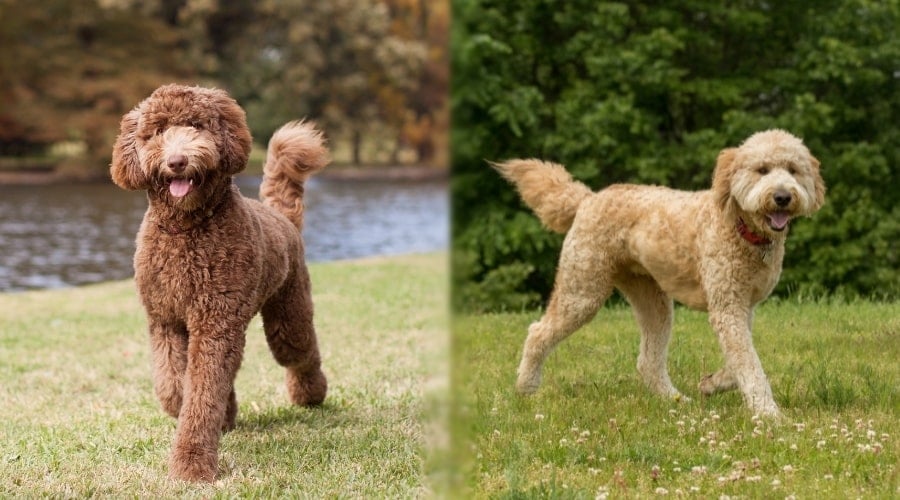
Both breeds share one parent, the Poodle, but their other parent can shape everyday life in very different ways. Labradoodles often inherit the Labrador Retriever’s athleticism, enthusiasm, and drive to stay busy. Goldendoodles frequently lean into the Golden Retriever’s affectionate, people-pleasing, and easygoing nature.
Of course, every doodle is an individual, but these inherited tendencies can make a noticeable difference in everyday life, so it’s important to compare the two breeds to determine whether your future dog fits seamlessly into your family or will become a much bigger commitment than you expected.
The good news is that once you understand what each breed typically excels at, the choice becomes that much easier.
Breed Differences at-a-Glance
At a glance, Labradoodles and Goldendoodles have a lot in common. Both are intelligent, affectionate Poodle mixes that can make fantastic family pets. But their personalities often develop in surprisingly different ways.
- A Labradoodle may be a better fit if you’re looking for a dog that’s highly active, eager to work, and thrives with structure and adventure.
- A Goldendoodle may suit you better if you’d prefer an outgoing, people-focused companion that’s happiest being part of every family moment.
- Whichever you choose, both breeds need regular grooming, daily exercise, consistent training, and realistic expectations about shedding and allergies, despite some common myths.
Of course, those are just the headlines. Genetics, generation, individual temperament, and more all play a role, and the differences between these two popular doodle breeds are more nuanced than most comparison guides suggest. Let’s take a closer look at what really sets them apart.
Breed Comparison
- Height13-24 Inches
- Height13-24 Inches
- Weight15-65 Pounds
- Weight15-100 Pounds
- TemperamentFriendly, Affectionate, Energetic
- TemperamentAffectionate, Kind, Fun
- EnergyHigh
- EnergyModerate to High
- HealthAverage
- HealthAverage
- Lifespan10-15 Years
- Lifespan10-15 Years
- Puppy Prices$1,000 and Up
- Puppy Prices$1,000 and Up
Labradoodle vs Goldendoodle: Which One Should You Choose?
Still torn between a Labradoodle and a Goldendoodle? Both breeds are affectionate, intelligent, and adorable, but they often suit slightly different households. Use this quick lifestyle guide to help narrow down which doodle may be the better fit for your family.
| Choose a Labradoodle if… | Choose a Goldendoodle if… |
|---|---|
| You want a more active, structured dog | You want a more social, people-focused dog |
| You enjoy training, hiking, fetch, or water play | You want a beginner-friendlier family companion |
| You can handle higher exercise needs | You prefer slightly easiergoing energy |
| You want a dog that may be more reserved with strangers | You want a dog that usually warms up quickly |
| You’re ready for grooming and allergy uncertainty | You’re ready for grooming and allergy uncertainty |
Labradoodle vs Goldendoodle: The Story Behind the Doodles
Labradoodle. Goldendoodle. The names sound like something out of a cartoon, and honestly, their personalities are just as charming. But these two beloved breeds didn’t just poof into existence with perfect curls and puppy-dog eyes.
In fact, their origins are rooted in a genuine purpose: one was designed as a guide dog with allergy-friendly appeal, while the other was created as the ultimate family-friendly fluffball.
So where did these doodle dynamos come from? And why has the world completely fallen in love with them? Let’s rewind the tail-wagging timeline and find out.
Labradoodle: The Allergy-Friendly Hero with a Heart of Gold
Born from a mission to create the perfect guide dog for allergy sufferers, the Labradoodle isn’t just a pretty face; it’s a purposeful pup with brains, bounce, and a loyal streak a mile wide.
The Royal Guide Dog Association in Australia was asked to provide a guide dog for a blind woman with allergies in 1989. The Labrador Retriever and the hypoallergenic Poodle were selected because they would be gentle on allergy sufferers while still retaining the qualities of an assistance dog.
This early cross became the foundation of the modern Labradoodle, and it quickly gained popularity worldwide as both a service dog and a family companion.
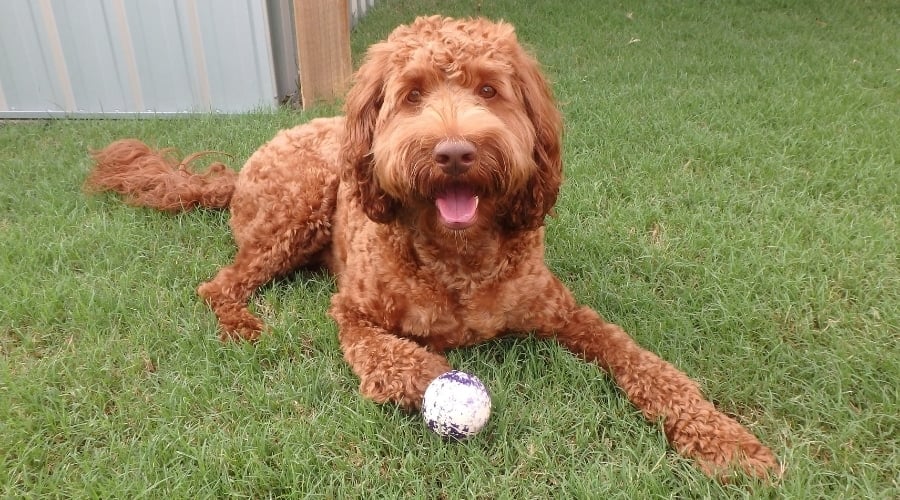
His Poodle parent comes in three different sizes: toy, miniature, and standard-sized. And this is also seen in the Labradoodle pool. Size doesn’t just determine a dog’s size; it also affects personality and energy levels. The Poodle originated in Germany and is a breed of dog specialized in duck hunting. So he has a lot of energy for sports and a love of water and ducks.
His Labrador parent is one of the world’s most popular dog breeds, and he is also a sporting dog with a lot of energy. Like the Poodle, he is favored for his love of the water and the ability to collect ducks and other birds from the shallows for his master. He is also skilled at driving fish into his master’s nets thanks to his webbed feet and otter tail. His eagerness to please his master makes him a fantastic assistance dog.
The Labradoodle cannot be registered with the American Kennel Club (AKC) because it is not a purebred dog. He can be registered with the Australian Labradoodle Association of America (ALAA). He is quickly becoming one of the most popular designer dog breeds.
Goldendoodle: The Sunshine Pup Everyone Falls in Love With
A mix of golden warmth and poodle smarts, the Goldendoodle was made to melt hearts. Friendly, affectionate, and always ready for a cuddle or a game of fetch, it’s the Golden Retriever of doodles — literally.
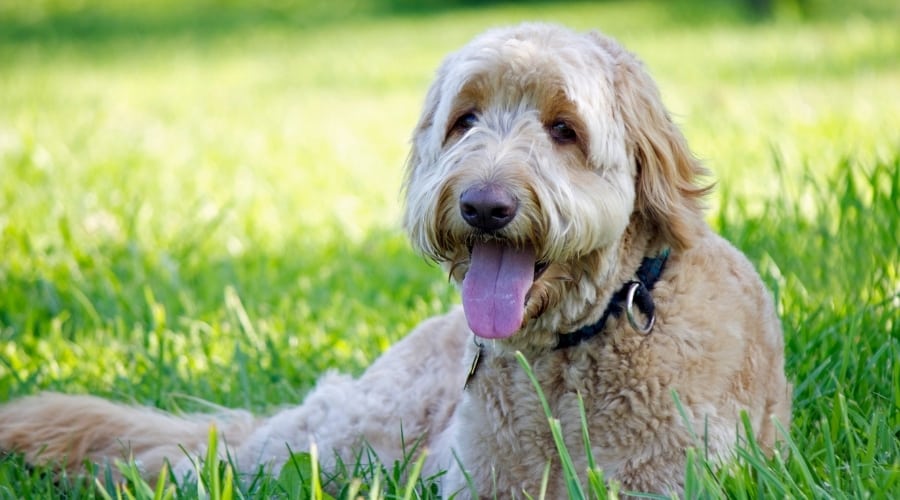
The Goldendoodle’s exact history is unknown, but it is thought that the Labradoodle inspired its creation. The Goldendoodle became popular in the 1990s. Like the Labradoodle, he cannot be registered with the AKC. Still, he can be registered with the Goldendoodle Association of North America (GANA). GANA is dedicated to promoting the Goldendoodle breed to official AKC recognition.
Because the Goldendoodle shares the same Poodle parent as the Labradoodle, it also comes in three sizes: toy, miniature, and standard. And he usually inherits the hard-working, water-loving traits of the Poodle.
The other half of his parentage is the Golden Retriever. He is a gun dog from Scotland, United Kingdom, also created to retrieve his master’s quarry. Mixing these genes and characteristics creates a very energetic dog with a high prey drive. If you are not certain of your dog’s genetic makeup, you can use an at-home DNA test kit to find out.
Labradoodle vs Goldendoodle: History Recap
- Labradoodle origins: Created in 1989 in Australia as a hypoallergenic guide dog.
- Goldendoodle origins: Inspired by the Labradoodle, it gained popularity in the 1990s.
- Shared parent: Both breeds share Poodle lineage—known for intelligence and low-shedding coats.
- Labradoodle traits: Draws from the energetic, loyal Labrador and water-loving Poodle.
- Goldendoodle traits: Combines the sociable Golden Retriever with the clever Poodle.
- Breed recognition: Neither is AKC-recognized, but both have dedicated associations (ALAA & GANA).
- Fun fact: Celebrity fans include Jennifer Aniston (Labradoodle) and John Travolta (Goldendoodle).
Labradoodle vs Goldendoodle Appearance: Key Differences
They both have those irresistible curls and puppy-dog eyes, but there are some subtle (and not-so-subtle) differences in size, coat, and color that might help you choose your perfect match.

Labradoodles and Goldendoodles tend to be around the same size. At maturity, both can reach heights of between 13 and 24 inches at the shoulder.
Depending on their size (miniature, medium, or standard), these breeds can be anywhere from 15 to more than 100 pounds. These varieties exist in both the Labradoodle and the Goldendoodle. Most standard-sized Goldendoodles will be bigger than the standard Labradoodle.
Goldendoodles can reach as much as 100 pounds, while a Labradoodle will likely grow to no more than 65 pounds. However, their ranges are similar enough that you could find a Goldendoodle and a Labradoodle of the same size. For example, both miniature breeds of these dogs tend to stay around the same size. Standard and medium Labradoodles are usually smaller than standard Goldendoodles.
Goldendoodles tend to boast coats that are gold, caramel, or red. Labradoodles come in a wide range of colors, including black, yellow, white, and chocolate, among others. Their coats are both relatively low-shedding, and they each have curly fur.
UC Davis notes that coat type in doodles depends on inherited genes, meaning even within the same litter, some puppies may shed more or less than others.
However, Labradoodles tend to inherit the characteristics of their Labrador parent in terms of fur. Though their poodle half is curly, their Labrador half is short and wiry. This combination typically results in shorter, less curly fur. A Goldendoodle takes on the traits of a Golden Retriever, which has long, thick fur. This results in longer, thicker, and curlier fur on the Goldendoodle.
Appearance Recap: Labradoodle vs Goldendoodle
- Size range: Both breeds come in toy, miniature, and standard sizes (13–24 inches tall).
- Weight differences: Goldendoodles can be heavier (up to 100 lbs); Labradoodles usually max at 65 lbs.
- Color range: Labradoodles come in a wider variety of colors (black, white, chocolate, etc.); Goldendoodles mostly gold, red, or caramel.
- Coat type: Goldendoodles tend to have longer, thicker curls; Labradoodles have shorter, less curly coats.
- Shedding: Both are low-shedding, but not guaranteed to be hypoallergenic.
- Teddy bear vibes: Both breeds are adored for their soft, fluffy teddy bear appearance.
Are Labradoodles or Goldendoodles Hypoallergenic?
This is one of the most common questions prospective owners ask, but the answer isn’t as straightforward as many breeders or social media posts make it seem.
The short answer is no; neither Labradoodles nor Goldendoodles are guaranteed to be hypoallergenic. While both breeds inherit low-shedding genetics from the Poodle, the Labrador Retriever and Golden Retriever are shedding breeds, making coat type and allergen levels unpredictable.
Even puppies from the same litter can develop very different coats. Some inherit a tight, curly Poodle-like coat that sheds very little, while others develop wavier or straighter coats that shed more. Because of this genetic variation, there’s no way to guarantee how much an individual puppy will shed as an adult.
You may also see F1B Labradoodles or Goldendoodles recommended for allergy sufferers. Because these dogs have a higher percentage of Poodle genetics, they often have curlier, lower-shedding coats than first-generation (F1) doodles. However, this is not a promise that they’ll be hypoallergenic or suitable for every allergy sufferer.
It’s also important to remember that pet allergies aren’t caused solely by fur. Many people react to proteins found in a dog’s dander, saliva, and urine, so even a dog that sheds very little can still trigger allergic reactions.
If someone in your household has allergies, the safest approach is to spend time with the individual dog before bringing it home. Visiting the breeder or foster home, handling the dog, and seeing how you react over several hours or multiple visits can provide a much better indication than relying on breed labels or marketing claims.
Cuddly or Crazy? Labradoodle vs Goldendoodle Temperament & Personality
While both breeds are affectionate and family-friendly, their personalities can differ more than you’d expect. One might be your shadow, while the other throws themselves into everyone’s arms.

As similar as the Labradoodle and Goldendoodle are to one another, they certainly have their differences. Even the fact that the Goldendoodle and Labradoodle share the same parent breed won’t change that. Because one pulls half its traits from a Labrador and the other from a Golden Retriever, they will have varying traits.
The Labradoodle is the more protective of the two breeds. However, neither of these dogs makes a very good guard dog. They may bark here and there, but in the end, they both direct their affection to anyone who comes into your house.
Life at Home: Labradoodle vs Goldendoodle
A Labradoodle may seem a little standoffish upon meeting strangers, but they typically warm up eventually. Goldendoodles are more likely to approach anyone, making as many friends as possible. Both of these dogs are very loyal, friendly, and affectionate to their masters. While their initial apprehension levels will vary by individual and personality, in the end, they make great pets for families due to their loving nature.
They both do well with strangers because they are very social and enjoy interacting with others, including other dogs. The Labradoodle tends to be more energetic, requiring more playtime and exercise to stay active. The Labradoodle is usually also the smarter of the two.
You may find that your Goldendoodle has a little more zest and less timidity. A Goldendoodle will provide anyone with a great time of play and laughter. But a Labradoodle will always be reliable and eager to please.
Temperament Recap: Labradoodle vs Goldendoodle
- Labradoodle personality: Slightly more reserved at first, protective, highly loyal, and intelligent.
- Goldendoodle personality: Outgoing, friendly with everyone, and enthusiastic.
- Social skills: Both are sociable, affectionate, and great with families and other pets.
- Energy levels: Labradoodles may be a bit more energetic and intense; Goldendoodles are easier-going.
- Trainability: Both are eager to please, though Labradoodles may respond more quickly to structure.
- Great family pets: Both breeds thrive in loving homes and enjoy being involved in all activities.
Zoomies or Chill Vibes? Labradoodle vs Goldendoodle Energy Levels
These pups are playful, energetic, and love to move—but how much energy you’re signing up for depends on the doodle. Knowing their exercise needs will help you avoid a bored (and mischievous) furball.
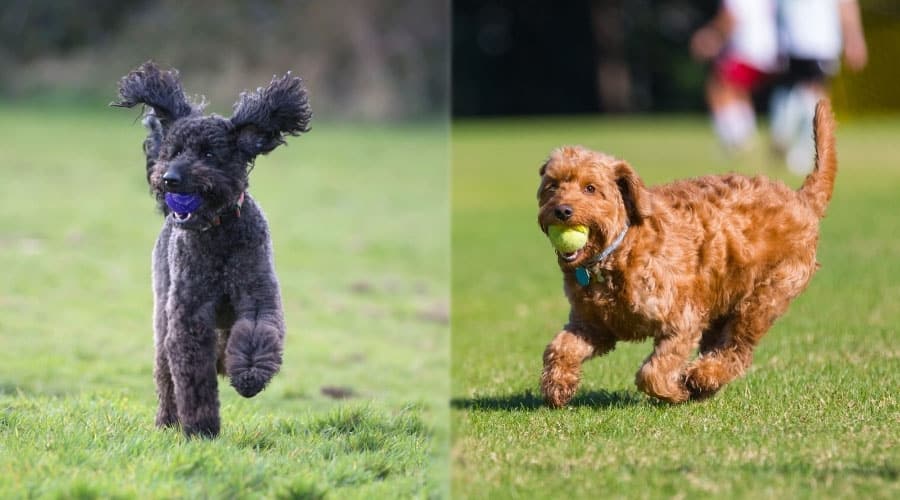
The Labradoodle is slightly more energetic than the two, but not by that much. Both of these pups need at least an hour of exercise every day. Unless, of course, you have a toy doodle. Then their little legs will need around 30 minutes. The Labradoodle is likely to need more intensive exercise to wear him out compared to the Goldendoodle.
The American Veterinary Medical Association recommends 30 to 120 minutes of daily exercise for active breeds. Both Labradoodles and Goldendoodles thrive in homes where walks, playtime, and mental stimulation are part of the daily routine.
Considering how much they both love the water, it’s a great idea to include the local lake or paddling pool in his exercise schedule. Another fantastic activity is to take them to the local dog park so they can have fun with their canine friends.
Exercise Recap: Labradoodle vs Goldendoodle
- Daily needs: Both breeds require at least 1 hour of exercise daily (30 mins for toy sizes).
- Activity levels: Labradoodles tend to need more vigorous or mentally engaging activities.
- Water play: Both breeds love water—swimming or water games are great ways to burn energy.
- Best fit: Active families or individuals who enjoy outdoor activities will suit these breeds best.
- Dog park friendly: They love social play with other dogs and excel in group settings.
- Mental stimulation: Puzzle toys, fetch, agility, or scent games keep boredom at bay.
Smarty-Paws Showdown: Labradoodle vs Goldendoodle? Which Doodle is Easier to Train?
If you’re dreaming of a dog who listens, learns quickly, and loves to please, you’re in luck. Both breeds are brainy—but one might be just a little more eager to impress.
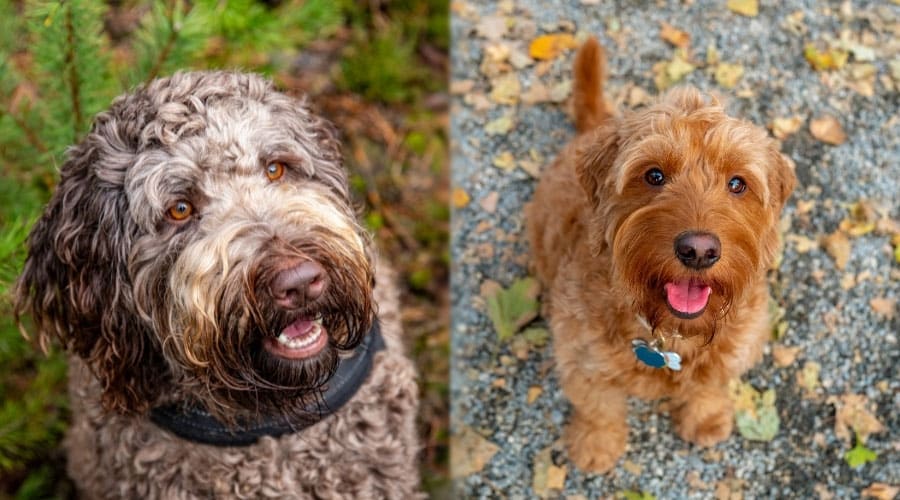
Labradoodles and Goldendoodles are both highly intelligent dogs that are often easy to train. The Labradoodle is generally thought to be the smarter of the two. They tend to be a little more loyal and reliable towards their owners, which makes training them a breeze.
However, it is key to remember that both breeds’ parents are highly trainable, so you shouldn’t have much of a problem with either. Both Golden Retrievers and Labradors make excellent, smart pets who know how to follow commands.
Since Goldendoodles are so friendly and relatively easy to train, they often work as service dogs in hospitals and nursing homes. It’s beneficial to socialize them and get them outside as much as possible.
It’s also important to remember that they will both need plenty of playtime and lots of exercise to be happy and ready to learn new tricks. They are both considered companion dogs rather than other breeds often used for labor or hunting.
Training Recap: Labradoodle vs Goldendoodle
- Highly trainable: Both breeds inherit intelligence from their Poodle parent.
- Labradoodle edge: Often slightly more obedient and responsive to structure.
- Goldendoodle perk: Extremely friendly and social, often used in therapy settings.
- Socialization matters: Early exposure to people, pets, and environments is essential.
- Consistency is key: Both respond best to positive reinforcement and routine.
- Play-based learning: Training is most effective when combined with fun and engaging activities.
Health Check: What Every Future Doodle Parent Should Know
Behind those wagging tails and goofy grins, doodles can inherit a few health hiccups. Knowing the risks upfront can save you heartache—and vet bills—down the line.
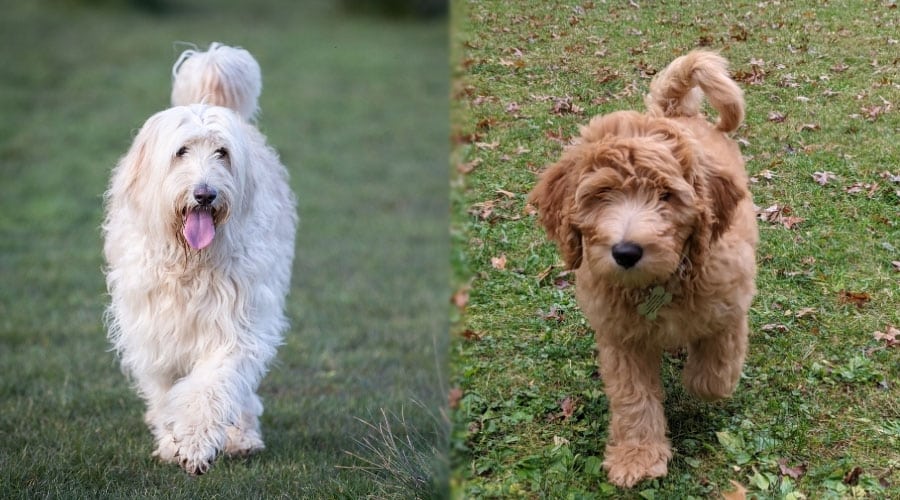
You may have heard that certain dog breeds are more susceptible to health issues than others. This is absolutely true, and it’s something important to consider before you choose your breed.
Because both Labradoodles and Goldendoodles are hybrids, there will always be questions about their physical, emotional, and health traits. All hybrid dogs have some potential to develop genetic health problems.
The Orthopedic Foundation for Animals (OFA) tracks breed health statistics, noting that both Labradors and Golden Retrievers have a predisposition to hip and elbow dysplasia, which doodles may also inherit.
These two doodle mixes also have a similar life expectancy. They each can live anywhere from 10 to 15 years.
Labradoodles
Labradoodles are more susceptible to ear infections. You must keep your Labradoodle’s ears clean, especially after they come into contact with water. Additionally, if you have a smaller pup, it is especially important to pay special attention to their dental health.
Labradoodles can inherit other health issues from both their Labrador and Poodle sides, including hip and elbow dysplasia, eye disease, and bleeding disorders. These health issues can be very uncomfortable for your pup and quite costly.
Goldendoodles
Goldendoodles can also develop a variety of health problems, especially if they didn’t come from a very careful, knowledgeable breeder. With that being said, because they are a mixed-breed pup like the Bernedoodle, they do tend to be healthier than other purebreds.
Some health issues to watch for in a Goldendoodle include allergies, knee and hip injuries, and epilepsy. This breed can also exhibit signs of night blindness, known as progressive retinal atrophy (PRA).

Health Recap: Labradoodle vs Goldendoodle
- Lifespan: Both breeds live 10–15 years on average.
- Common issues in both: Hip dysplasia, eye diseases (PRA), and allergies.
- Labradoodle concerns: Ear infections, bleeding disorders, and dental disease (especially in small sizes).
- Goldendoodle concerns: Skin allergies, epilepsy, joint problems.
- Health tip: Buy from responsible breeders who screen for genetic health conditions.
- Pet insurance: A good idea for both breeds—especially if enrolled early before issues develop.
Could Pet Insurance Help?
If your pet insurance covers exam fees and your dog needs to be examined, there is a good chance your policy will reimburse those costs based on your policy details. However, if you are a new customer, vet expenses will not be covered until after your policy’s defined waiting periods, so signing up once you have an existing health concern will not help this time. Pre-existing conditions are not covered by any current pet insurance plans.
This is why it is a great idea to sign up for pet insurance when your pet is young and relatively healthy, so you will be covered when you need it most.
Food, Glorious Food: Labradoodle vs Goldendoodle Nutrition
Whether you’ve got a mini-moocher or a standard-sized snacker, feeding your doodle well is one of the best ways to keep them happy, healthy, and full of tail wags.

Overall, toy-sized doodles will eat much less than standard-sized doodles. Larger doodles will eat between two and three cups of food, and toy-sized pups sometimes eat as little as half a cup a day.
When it comes to nutrition, the most important thing you can do for your Labradoodle or Goldendoodle is to feed them the highest-quality kibble you can afford.
Choose a complete and balanced food appropriate for your dog’s size, age, activity level, and health needs. Ask your vet about calories, body condition, and whether the manufacturer follows WSAVA-style nutrition standards
Both dogs have a strong appetite, but Labradoodles are particularly food-motivated and are more likely to be the greedier of the two breeds. To avoid obesity, it’s important not to overfeed them.
Feeding Guidelines:
- Toy doodles: ~½ cup per day
- Standard doodles: 2–3 cups per day
What to Look for in Dog Food
- High-quality animal protein (chicken, lamb, salmon) as the first ingredient
- Omega fatty acids (like flaxseed or fish oil) for coat health
- Whole grains or grain-free carbs like sweet potato for energy
- Avoid fillers like corn, wheat, or artificial colors
- Calories: Aim for ~25–30 calories per pound of body weight per day
Always consult your vet for specific nutritional needs, especially during puppyhood or senior years
Curls, Coats & Clippers: Labradoodle vs Goldendoodle Grooming Needs
Whether you bring home a Labradoodle or a Goldendoodle, expect to invest time and money in coat maintenance. Breeders often market both breeds as low-shedding, but neither dog has a low-maintenance coat.
Those bouncy curls might look effortless, but doodle coats need TLC. A solid grooming routine can mean the difference between being “adorable” and looking like a “matted mop.”
Most Labradoodles and Goldendoodles require brushing several times a week to prevent tangles and remove loose hair. Dogs with curlier, Poodle-like coats may even benefit from daily brushing, while wavier coats still require consistent upkeep to stay healthy.
In addition to regular brushing, expect to schedule professional grooming every 6 to 8 weeks. Routine trims help keep the coat manageable and reduce the likelihood of painful mats forming close to the skin.
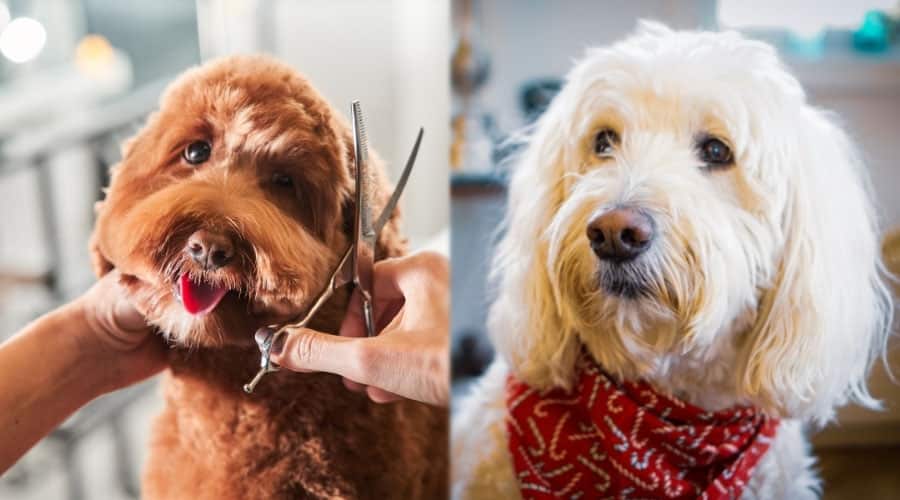
The Labradoodle and the Goldendoodle have very similar coats, meaning their grooming regimes are also very similar. Goldendoodles don’t shed much, and neither do Labradoodles when compared with their Golden Retriever and Labrador parents. This is a significant appeal to many families.
Neither a Labradoodle nor a Goldendoodle makes the best fit for owners who want a low-maintenance coat. However, owners who keep up with brushing and regular grooming appointments can maintain a healthy, comfortable coat and make long-term care much easier.
Grooming Recap: Labradoodle vs Goldendoodle
- Regular brushing is needed: 3–5 times per week to prevent matting.
- Low shedding: Both breeds shed far less than their Retriever parents.
- Professional grooming: Every 6–8 weeks is typical, especially for larger sizes.
- Bathing: Every 6–8 weeks with gentle, skin-sensitive shampoo.
- Tools to have: Slicker brush, dog-safe clippers (if trimming), and a detangler.
- Not fully hypoallergenic: Despite the Poodle mix, no guarantee that either doodle won’t trigger allergies.
What’s the Damage? Puppy Prices & Long-Term Costs Explained
Love may be free, but doodles aren’t. From initial costs to lifetime care, here’s what to expect—plus why adoption might be the best budget-friendly (and heartwarming) option.
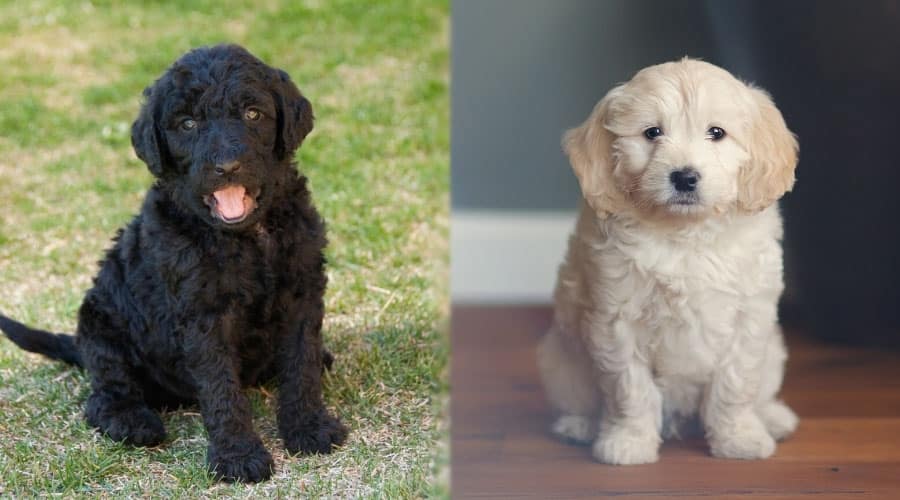
If you’re concerned about price, it’s worth noting that Goldendoodles are generally more affordable. From a breeder, you can expect to pay around $1,000 for a Goldendoodle. Labradoodles typically cost between $1,000 and $2,500.
Of course, these prices will vary depending on the breeder and location. You also need to remember that there are ongoing costs associated with dog ownership, in addition to the initial puppy price.
At the same time, you can always try your luck rescuing a Goldendoodle or Labradoodle at your local rescue shelters. There’s no guarantee you can find exactly the breed you’re looking for. But you never know when you’ll find a Labradoodle or Goldendoodle in need of a loving home. Rescuing a dog is often a lot less expensive than buying a brand-new puppy.
Before adopting or buying, meet adult dogs of these breeds to understand their temperament. You can also consult reputable breeders and veterinarians to assess inherited health conditions.
Cost Recap: Labradoodle vs Goldendoodle
- Goldendoodles: Generally range from $1,000–$1,500.
- Labradoodles: Can cost $1,000–$2,500, depending on breeder and location.
- Ongoing costs: Food, grooming, vet care, training, and accessories add up over time.
- Rescue options: You may find doodles in shelters, though availability is limited.
- Adoption perks: Rescuing saves money and gives a dog in need a loving home.
- Do your research: Choose reputable breeders or shelters to avoid health and behavioral issues.
Lifetime Costs of Owning a Doodle
Owning a Labradoodle or Goldendoodle is a long-term investment. Over their 10–to 15–year lifespan, you can expect to spend an average of $15,000 to $20,000 in total care costs. This includes food, veterinary care, grooming, and other essentials.
Annual expenses typically range from $1,500 to $2,500, with professional grooming often adding an additional $500 to $1,000 per year for doodles. Factoring in pet insurance and preventative care helps reduce surprise expenses and ensures your pup stays healthy throughout their life.
Labradoodles vs Goldendoodles FAQs
Still comparing couch cuddles, grooming bills, allergy concerns, and daily zoomies? Many future doodle owners reach this point with the same big question: which pup will actually fit their life?
Below are some of the most common questions people ask when deciding between Labradoodles and Goldendoodles, including topics such as allergies, first-time ownership, and doodle generations. If we missed yours, let us know in the comments.
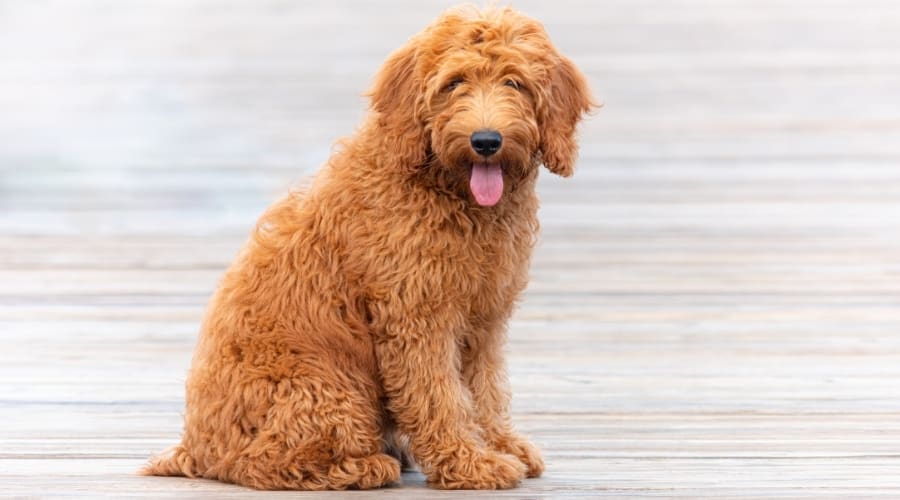
Is a Labradoodle or Goldendoodle better for first-time dog owners?
Both can make excellent pets for first-time dog owners, but Goldendoodles are generally more easygoing, social, and forgiving of beginner mistakes. Labradoodles tend to be more energetic and may require firmer training, making them a slightly better fit for active owners who enjoy structure.
Which doodle breed is better for people with dog allergies?
Neither Labradoodles nor Goldendoodles are guaranteed hypoallergenic, but F1B generations—especially those with more Poodle genetics—tend to shed less and produce fewer allergens. Allergy sufferers should always spend time with the dog before adoption and consult with an allergist.
What’s the difference between an F1 and an F1B doodle?
An F1 doodle is a 50/50 cross between a Poodle and a Retriever (Labrador or Golden). An F1B doodle is 75% Poodle and 25% Retriever, often bred to enhance coat curl and reduce shedding. F1B doodles are usually better for households with allergy-sensitive members.
Labradoodle vs Goldendoodle: Which Doodle Fits Your Lifestyle?
If you’re still deciding between a Labradoodle and a Goldendoodle, the best choice comes down to your lifestyle and expectations, not which breed is “better.” Both breeds make wonderful family companions, loyal, affectionate, and easy to train. Goldendoodles often lean more social, while Labradoodles tend to be higher-energy and sometimes more independent. But because doodles are hybrids, their personalities can vary widely.
Ultimately, both Labradoodles and Goldendoodles make intelligent, loving companions in the right home. Consider your activity level, grooming commitment, family dynamic, and lifestyle so you can choose the doodle that best fits your life for the next decade or more.
If you’re unsure whether a doodle is the right fit, start with our guide on deciding if you’re ready for a dog. Families with children may also find our tips on age-appropriate dog duties helpful. For bonding ideas, check out ways to show your dog you love them. And if adoption appeals to you, learn more about how to adopt a dog responsibly. Whichever doodle you choose, being informed and prepared ensures a happy match and many joyful years with your new best friend.
Labradoodle vs Goldendoodle: Which Do You Prefer?
Now that you know the key differences between Labradoodles and Goldendoodles, which one do you see fitting best into your life? Both breeds bring joy, loyalty, and energy in their own unique ways.
Share your thoughts in the comments below: Are you team Labradoodle or team Goldendoodle?